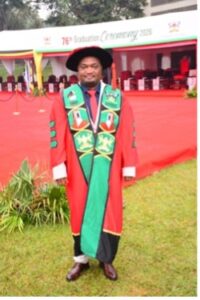
Dr. Stanley Elias Kiswaga is a Lecturer in the Department of Literature at the University of Dar es Salaam, Tanzania, and a Postdoctoral Research Fellow at the Makerere Institute of Social Research (MISR), Makerere University, Uganda. He holds a PhD in Social Studies from Makerere University, an MPhil in Social Studies from MISR, Makerere University, an MA in Literary and Cultural Studies from Airlangga University, Indonesia, and a BA with Education from the University of Dar es Salaam.
From 2023 to 2026, Dr. Kiswaga was also a fellow from the Social Science Research Council’s (SSRC) Next Generation Social Sciences Program. Through these fellowships and research opportunities, he has developed an interdisciplinary approach that combines ethnography, literary analysis, archival research, and performance studies.
His research interests are literary and cultural studies, performance studies, nation-building, identity, belonging, displacement, and everyday practices of inclusion in Africa.
1. APDD: Briefly describe the central argument of your doctoral dissertation. What is its main contribution to knowledge in your field?
My doctoral dissertation, titled “Theatre for Development and the Nation: Rethinking Nation-Building in Post-Socialist Tanzania,” examines how Theatre for Development (TfD) has shaped and challenged nation-building in post-socialist Tanzania. While TfD is often celebrated as a participatory approach that gives communities a voice, I argue that its practice is marked by complex power relations involving the state, universities, development agencies, artists, and local communities. Rather than viewing TfD simply as a tool of resistance or state control, the dissertation shows how these actors continually negotiate, contest, and reshape ideas of the nation. Drawing on archival research, literary analysis, performance observations, and oral interviews, I demonstrate that grassroots communities are not passive recipients of development or national narratives. Even within unequal power structures, they create spaces to reinterpret official narratives, challenge dominant assumptions, and articulate alternative visions of nationhood grounded in everyday experiences. I describe these moments as “spectacles of absurdity” that reveal a “poetics of negotiation,” through which ordinary people exercise cultural and political agency.
The dissertation contributes to scholarship by offering a new way of understanding popular theatre beyond the familiar frameworks of resistance, co-option, and participation. It highlights how popular performance serves as a dynamic site where nationhood is continuously negotiated and reimagined from below, expanding debates in literary and cultural studies, performance studies, and African political thought.
2. How did the Next Gen Fellowship program impact your doctoral journey?
The three Next Gen Awards that I received in 2023 (Proposal Development), 2024 (Dissertation Research), and 2025 (Dissertation Completion) provided financial stability that enabled me to concentrate fully on my research without the constant pressure of seeking alternative sources of income. This stability allowed me to complete my dissertation within the five-year timeframe—an accomplishment that remains relatively rare within my institutional context.
In addition to financial support, the workshops organized by the APN and Next Gen programs opened the door to mentorship and a vibrant academic network that provided valuable feedback and guidance, strengthening the quality and rigour of my work. The program facilitated the development of an important trans-African intellectual network that continues to shape my academic engagement beyond the PhD. I remain deeply appreciative of the support and opportunities provided throughout these phases of the now-APDD program.
3. Now that you have completed your PhD, what are your plans for the future?
I am currently working as a Postdoctoral Research Fellow at the Makerere Institute of Social Research, Makerere University, Uganda. As part of my postdoctoral work, I am transforming my doctoral thesis into a book. In addition, I am involved in co-teaching courses on Contemporary African Popular Arts and Culture and African Literature and Critical Traditions for MPhil students.
I plan to continue advancing my research, publications, and teaching activities while contributing to broader conversations in African literary and cultural studies.
4. What advice do you have for upcoming doctoral students?
My advice to anyone preparing to begin a PhD is to start by choosing a research topic that genuinely interests and motivates them. A strong connection with the topic will provide the commitment and curiosity needed throughout the journey. It is equally important to find a supportive mentor and build meaningful relationships with colleagues and other scholars who can provide guidance, encouragement, and intellectual exchange. These foundations can make a significant difference in navigating the challenges of doctoral studies.
A PhD requires patience, dedication, and consistent effort. I encourage aspiring doctoral students to remain committed to their work, stay open to learning, and approach challenges as opportunities for growth. The journey is not always easy, but curiosity, persistence, and resilience are essential qualities for success. Above all, remember to take care of your physical and mental well-being, as personal health is fundamental to sustaining the demands of doctoral research.
Selected Publications
- Elias, Stanley. 2026. “Rethinking the Interpretative Limits of Theatre for Development and the Politics of Nation-Building in Post-Socialist Tanzania.” Mambo! Working Paper Series, No. 111.
https://mambo.hypotheses.org/5865 - Elias, Stanley. 2025. “Politics of Neopatrimonialism and the Dynamics of Nationalization Policy in the ‘Socialist Tanzania’.” Indonesian Journal of Political Studies 5(1): 77–91.
DOI: https://doi.org/10.15642/ijps.2025.5.1.77-91
Book Review
- Elias, Stanley. 2025. “Review of Ellen Vea Rosnes, Pierre Guidi, and Jean-Luc Martineau (eds.), History Through Narratives of Education in Africa: Social Histories in Times of Colonialism and Post-Independence (1920s–1970s).” Research Africa Reviews 9(1): 50–53.
https://researchafrica.duke.edu/sites/default/files/-5-9-Social-History-Education-in-Africa-1-2025.pdf