

David J. Francis, Governing a Poor Country: Perspectives from a Former Chief Minister of Sierra Leone, London: Adonis & Abbey Publishing Ltd, 2026. 155 pp. £16.68 (paper), ISBN 9781913976743.
Reviewed by Kenneth Omeje
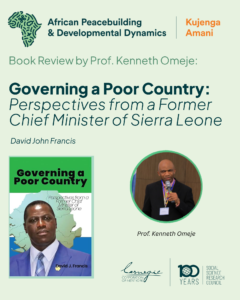
Governing a Poor Country is a thought-provoking anthology written by David Francis in which he intellectually reflects on his time in office as the first post-independence Chief Minister of Sierra Leone (April 2018 – April 2021). David Francis is an easily recognisable name in African peace, security, and development scholarship and policy circles. Prior to his foray into Sierra Leonean politics, Francis was an accomplished Professor of African Peace and Conflict Studies at the Department of Peace Studies and International Development, University of Bradford, as well as Founder and Director of the John and Elnora Ferguson Centre for African Studies (JEFCAS) in the same university.
In this anthology, Francis assesses the historical evolution, functions, political context, and impact of the role of Chief Minister of Sierra Leone (p.17). The book asks and addresses the central question – why is Sierra Leone described as a “poor and underdeveloped country” despite the enormous natural resources and comparative colonial head-start advantage that the country has over most countries of Sub-Saharan Africa in areas like education, socio-development, and governance infrastructure? The author answers the question creatively by arguing that Sierra Leone has no business being a poor and underdeveloped country but for the virulent nature of its domestic politics, which is “based on neopatrimonial governance.” In this context of neopatrimonial governance, Francis continues, “…there is no distinction between the public (res publica as it pertains to the public realm of the state) and the private realm of the state and governance…This type of prebendal politics creates an informal system of governance that informalizes and privatises all the state’s governing institutions to serve the vested interests of those in power, leading to bad governance, rampant corruption, and state capture” (p. 22).
Francis explains in detail, without sounding pessimistic or apologetic, how the local context of neopatrimonial governance and prebendal state capture adversely impacted his position and role as Chief Minister in the “Sierra Leone People’s Party (SLPP) New Direction Government of President Bio.” Julius Maada Bio, who was Sierra Leone’s former military Head of State for roughly three months in 1996 and SLPP’s defeated presidential candidate in the Sierra Leone 2012 Presidential Election, contested and won the 2018 election using the popular campaign slogan “Change and a New Direction.”
In Chapter One of the book, the author recounts the relational context of how Maada Bio, the current President of Sierra Leone, used to be his doctorate degree supervisee at the University of Bradford between 2014 and 2017, a relationship that essentially laid the foundation for Francis’ eventual appointment as Chief Minister when Bio won Sierra Leone’s presidential election in April 2018, having suspended his doctorate degree programme in Bradford. I was privy to this relational context, having worked as a Senior Research Fellow at JEFCAS then.
Francis narrates the history of the office of Chief Minister in Sierra Leone. The office of Chief Minister was first introduced in Sierra Leone during the colonial era in 1954 by the British colonial authority, with Dr Milton Margai of the SLPP, the leader of the majority party in the Legislative Assembly, as the first holder of the post. Sierra Leone was then ruled by a representative of the British Crown, the colonial Governor-General, who appointed the Chief Minister to head the Executive Council. A subsequent constitutional reform in 1958 changed the title of Chief Minister to Premier, and upon Sierra Leone attaining political independence on 27th April 1961 (under a parliamentary system of government), the post was transformed to Prime Minister and Head of Government. Dr Milton Margai held this position in its three mutative forms until his death in 1964. Under the 1971 Republican Constitution, Sierra Leone’s ruling All People’s Congress (APC) government of Siaka Stevens repealed the parliamentary system of government in favour of the presidential system. Following the 1978 constitutional referendum that replaced multi-party democracy with a one-party state, the office of Prime Minister was abolished.
In terms of constitutional power, it is indicative that the elected Chief Minister at the eve of Sierra Leone’s independence was vested with greater power as head of the Executive Council—especially when compared to the reinvented Chief Minister of the “new direction government” of President Bio, who is an appointee of the President and holds his office at the pleasure of the latter, essentially wielding the power delegated by the President in relation to the super-ministerial office and devolved tasks. Nonetheless, the position of Chief Minister is primus inter pares among all the cabinet ministers, and the office holder is the third most powerful person in the executive arm of government, after the President and Vice President.
Francis underscores the marked excitement and apprehension that his appointment to the office of Chief Minister generated in the parliament across party lines, and also in the mainstream media and among the public. Many critics and sceptics inter alia construed the position as an unnecessary (if not “unconstitutional”) “usurpation of the office and mandate of the Vice President.” But citing the relevant constitutional provisions that grant the President the executive power to make all appropriate ministerial and all other office appointments necessary for running the affairs of the state, Francis makes a strong defence for the constitutionality of the office of Chief Minister, which led the parliament to approve his appointment in the first place. Among other things, “..the plan for the role of Chief Minister is to facilitate and provide competent leadership that will ensure that what has been decided by the President and Vice President is cascaded to the line ministries for implementation” (p. 36). The Chief Minister is “…the principal senior minister responsible for the supervision, coordination and follow-up, performance management, and monitoring of the 28 New Direction Government of Sierra Leone (GoSL) ministries and 14 legislated agencies within the Office of the President” (p. 59).
In an apparent contradiction of the preceding remark about “the plan for the role of the Chief Minister,” Francis stated that, from the onset, when President Bio appointed him as Chief Minister, there was no job description or terms of reference outlining the roles, functions, and mandate of the Chief Minister and the Office of the Chief Minister. However, this “confession” was not intended to be an indictment on the judgment of the President but was, ostensibly, a reflection of the level of confidence and camaraderie that existed between the President and Prof Francis at the time. As Francis further explained: “Under the President’s and Vice President’s monitoring and guidance, I was given a free hand and political support, backed by the President’s authority and power, to establish and operationalise the role and mandate of the Chief Minister …” (p. 57).
Regarding his experiences while in office as Chief Minister, Francis remarks that against the backdrop of the dominant political culture of neopatrimonialism, he entered the governance terrain as “an outsider to the neopatrimonial and Shadow State,” bringing within him a “professionalised and technocratic governance approach, perceived by the citizens as a welcome break from the previous nepotistic, privatised, rent-seeking, and ‘Padi-Padi’ (informal and friendship-based) governance status quo” (p. 113).
In his self-assessment, this “technocratic and non-interest-based approach to governance” enabled him to initiate, promote, and support the implementation of key development projects of lasting impact on the lives of the people, notably his leadership in:
- Securing donor funding for the expedited construction of the Sengbe Pieh Memorial Bridge at Juba/Lumley in Freetown; and
- the Kenema City development projects including the construction of a network of tarmac roads, an iconic Clock Tower, the new Kayfrey Bridge, leading the establishment of the new Eastern Technical University to replace the Kenema Polytechnic and the establishment of an Endowment Fund for the university, financing the purchase of a local health centre premises for the Kakajama community leveraging access to healthcare delivery including maternity service for more than 2,000 people, etc (pp. 116-121).
Francis further narrates that as Chief Minister, he served as one of the key principal advisers to the President and was responsible for initiating a number of government policies and Presidential Executive Orders, sat in all the high-profile presidential policy and strategic governance meetings, and accompanied the President as part of high-profile delegations / state visits to different countries and multilateral engagements with diverse international organisations and fora. As Chief Minister, he also set performance benchmarks and a review system for cabinet ministers known as ‘Ministerial Presentation to the President,’ undertook monitoring visits to all government ministries and strategic projects to assess progress, organised periodic policy implementation and governance retreats for cabinet ministers and other top government functionaries, and so forth.
There were some downsides and governance failures, which the author acknowledges. For instance, Francis observes that coming from the Western ivory tower, which is largely insulated from the crude Machiavellian politics of the institutional state system, he was not prepared for the harsh realities of the negative political culture whereby governance is extremely ‘informalized’ to the point that state governing institutions are subverted to serve the selfish interest of the hegemonic elites often at the expense of service delivery to the people (p. 122). In this book, the author explains that he witnessed firsthand the subversive operation of the “Shadow State,” those powerful social agents mostly but not entirely outside the formal state system who believe that “they own the President,” and whose interests the President always finds himself in an invidious dilemma to protect. Francis gave different examples of where well-meaning government policy proposals were aborted, subverted, and shelved because of the sustained efforts and influence of the “Shadow State,” who always takes anti-progress actions to protect their “rent-seeking” and “private accumulation” interests. Two major examples include the Chief Minister’s failure to secure cabinet approval to establish the first-ever National Reforestation and Timber Governance Agency, as well as the failure to deliver on the menace and health hazards of plastic pollution, even with the support of the Ministry of Environment and Forestry. In both cases, the GoSL Sole Timber Agent and the entrenched powerful interest groups in the plastic industry coalesced to prevent any government’s policy intervention on the issues.
The Shadow State politics, as Francis posits, is aggravated by the fact that colleague ministers, presidential appointees; heads of state-owned enterprises, parastatals and commissions, and parliamentarians from the same ruling party often deliberately undertake actions to undermine and delay the implementation of government programmes and projects, even presidential directives as long as it did not serve their vested resource-extraction and neopatrimonial accumulation interests (p. 83).
Besides the hegemonic elites, Francis avers that the ruling party officials and grassroots citizens, on their own part, perceive political power as being synonymous with patronage. He recounts the bewildering experience of how, in the first four months of their SLPP government coming to power, State House was often crowded with party leaders and grassroots supporters who had sacrificed so much to bring the SLPP to power and elect President Bio. They all “inundated the President and State House with requests for job appointments, financial support for school fees, medical treatment, paying of house rents, student scholarships, Hajj pilgrimage, and all manner of requests that had nothing to do with state governance” (p. 130).
Francis concludes that, given the devastating impact of neopatrimonial politics and the unbridled poverty mentality in the country, Sierra Leone is destined to remain poor and underdeveloped for the next 50 years if audacious and sustained efforts are not made by the political class to prioritise a competent, disciplined, and people-centred leadership. This conclusion sounds candid but scary.
In this remarkable book, Francis spares the presidency and the President of any harsh critique, despite the buck of governance in any presidential democracy stopping with the President. The author was hesitant to apportion blame – apparently because of his disclaimer that “the book does not set out to blame, accuse, or ‘name-call’ any party, actors or agencies …” This punch-sparing approach is a shortcoming of the book, and certainly will not sit well with many readers who could be tempted to perceive the anthology as overly pro-establishment, especially when the book is advocating for transformative change.
Despite its shortcomings, there is no doubt that Governing a Poor Country is an outstanding contribution to the understanding of neopatrimonial politics and governance in Africa. The book provides fresh empirical evidence and analytical insights, which enrich the understanding of neopatrimonialism in African politics, especially its structural embeddedness and obstructive dynamics.
I consider this book a must-read for all students, lecturers, researchers, and policymakers interested in understanding the nexus between political theory and praxis in the African context, particularly in explanations for why many African countries have remained poor and underdeveloped, and what can be done to break the vicious cycle.
