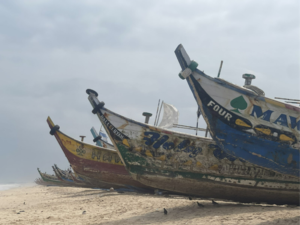
Amid growing concerns over declining fish stocks and increasing pressure on marine resources, Ghana’s coastal communities continue to face the difficult challenge of balancing conservation with livelihood survival. Artisanal fisheries remain central to food security, employment, and social stability along the country’s coastline. The closed season policy, first introduced for the industrial trawl sector in 2016, was extended to the artisanal sector in 2019 after an unsuccessful attempt in 2018, following strong opposition from local fisherfolk over the timing and implementation of the policy. Since then, the policy has been intermittently implemented across the artisanal sector.[1]
It was within this context that the research project Creating Synergies Between Indigenous Practices and Scientific Knowledge (ISPSK) was developed to examine the gendered impacts of Ghana’s fisheries closed season and explore how indigenous and local knowledge can be integrated with scientific knowledge to achieve equitable and sustainable fisheries governance.[2] As the project evolved through extensive engagement with fishing communities and stakeholders, it adopted the name Sankofa, derived from an Akan concept meaning “go back and retrieve it.”
Led by the University of St. Andrews in collaboration with the Fisheries Commission of Ghana, the Fisheries Committee for the West Central Gulf of Guinea (FCWC), and the Canoe and Fishing Gear Owners Association of Ghana (CaFGOAG), with support from the Pew Fellows Program in Marine Conservation at The Pew Charitable Trusts, the project combined research with community engagement across Ghana’s coastline.[3] Data collection began at the onset of the 2024 closed fishing season, covering 15 fishing communities across the Volta, Greater Accra, Central, and Western Regions, engaging more than 830 participants. This was followed by validation exercises in 2025 and 2026 involving more than 500 participants across 33 communities, including the original research sites.[4]
The significance of the Sankofa project became evident in its policy uptake. At the launch of the project findings in February 2026, Ghana’s Minister for Fisheries and Aquaculture referenced the research in announcing that the 2026 closed season would not be extended to artisanal fishers in its current form.[5] Instead, the Minister emphasised the revitalisation and enforcement of traditional weekly fishing holidays across coastal communities, reflecting one of the project’s central findings: artisanal fishers are not opposed to conservation, but often support locally grounded and socially legitimate approaches to resource management.[6] In this context, the decision to suspend the closed season in the artisanal sector is not a retreat from conservation, but a shift toward a more evidence-based and community-informed approach to fisheries governance.[7]
As the Minister noted during the launch, “The findings of the Sankofa Project provide a critical foundation for developing equitable fisheries livelihoods and informing evidence-based policy.”[8] That statement reflected a careful reading of the evidence emerging from the research. While conservation measures are urgently needed, the findings showed that the current closed season model places disproportionate socio-economic pressure on artisanal fishing communities while remaining poorly aligned with ecological cycles and existing local conservation practices. The research also demonstrated how poorly designed conservation measures can deepen household vulnerability, intensify economic insecurity, and weaken trust between fishing communities and state institutions.
In that moment, policy aligned with evidence.
Ghana’s fisheries are under undeniable strain. The sector comprises artisanal (canoe-based), semi-industrial, and industrial fleets operating within the same marine space but with very different scales, technologies, and livelihood dependencies. Within this structure, artisanal fisheries remain the backbone of coastal economies and food security, providing the primary source of income and nutrition for millions of people in coastal communities. Small pelagic stocks, often referred to as “the people’s fish,” are in steep decline, threatening livelihoods and economic and food security. The Sankofa research reinforces this urgency: 90% of fisherfolk surveyed across coastal regions reported a decline in fish catches over the past decade, while 82% agreed that conservation measures are necessary.[9] There is no ambiguity here; action is required.
The question, therefore, is not whether artisanal fishing communities should contribute to conservation efforts. The evidence from the Sankofa project suggests that many already do, both through support for conservation measures and through longstanding traditional management practices.[10] The more important policy question is whether the burden imposed by the current closed season model is proportionate, appropriately timed, and equitably distributed across sectors operating within Ghana’s marine space.
Many respondents questioned why a July closure, imposed during a period of relatively active fishing, should take precedence over locally recognised periods of reduced fishing activity in May and June, when rough sea conditions already limit fishing effort naturally.[11] From the perspective of many coastal communities, the issue is not the existence of conservation measures, but whether those measures are designed in ways that minimise unnecessary socio-economic harm while still achieving ecological objectives.
What remains contested, however, is how that action should be designed.
The closed season policy, as currently implemented, rests on a simple premise: temporarily halt fishing within the “biological period” to allow stocks to recover. In theory, it is sound. In practice, the Sankofa findings reveal important limitations. Only 26% of surveyed fisherfolk considered the July closure effective.[12] This is not a rejection of conservation, but a critique of its misalignment with ecological cycles and fishing realities known to the communities over centuries of their interaction with the ocean. Across the four coastal regions studied, fisherfolk consistently identified May and June, months characterised by rough seas and naturally reduced fishing activity, as more appropriate periods for a closure.[13] In effect, what policy imposes in July, nature already enforces earlier in the year.
This distinction is important because the socio-economic burden associated with temporary restrictions is significantly lower during periods when fishing effort is already constrained by environmental conditions. A July closure, however, interrupts a more active fishing period, intensifying livelihood losses and increasing pressure on households already facing economic insecurity.[14]
The timing of the closure also has broader governance and human security implications. Poorly aligned interventions do not simply risk weak ecological outcomes; they can also generate social and economic pressures within already vulnerable coastal communities. Fisherfolk reported intensifying fishing effort before and after the closure to compensate for lost income, sometimes resorting to unsustainable practices to guarantee a catch. In many communities, traditional weekly fishing holidays are suspended months before the closure to offset anticipated economic losses, effectively normalising fishing on days historically reserved as rest periods for the sea.[15] In such circumstances, the policy risks becoming counterproductive.
The socio-economic consequences are stark. For roughly 70% of fisherfolk, fisheries constitute the primary source of household income.[16] A closed season, therefore, represents a temporary collapse of livelihoods, with ripple effects extending far beyond the individual fisher. The Sankofa research documented reduced household food security, disruptions to children’s education reported in 60% of households, and increased reliance on debt and precarious coping strategies.[17] Some communities reported increases in theft and other forms of insecurity associated with worsening economic conditions during the closure period.[18] These findings are significant because they illustrate how conservation measures that fail to account for livelihood realities can generate broader forms of instability within economically vulnerable coastal communities.
Some fisherfolk also migrate to illegal mining areas in search of alternative sources of income, exposing themselves to serious environmental and health risks.[19] This movement into precarious livelihoods reflects the wider vulnerabilities that can emerge when conservation measures are implemented without adequate livelihood safeguards or alternative economic support.
The impacts of the closed season are also deeply gendered. While male and female fisherfolk reported broadly similar livelihood disruptions, the burden of coping within households was unevenly distributed. Women, who dominate post-harvest processing and fish trading, consistently reported a greater burden of domestic responsibility during the closed season. Across all four coastal regions, respondents described how the inability of crew fishers and fish traders to generate income or provide fish for household consumption shifted responsibility onto women to sustain household welfare and food security. In many cases, women bore the primary responsibility for filling both income and subsistence gaps created by the closure.[20] Any conservation policy that fails to account for these intra-household dynamics risks deepening existing inequalities and undermining social well-being in coastal communities.
Yet perhaps the most important contribution of the Sankofa project is its challenge to a persistent false dichotomy: that artisanal fishers are inherently at odds with conservation. The evidence suggests the opposite. Across Ghana’s coastal communities, fisherfolk have long practised forms of resource management, including weekly fishing holidays, seasonal bans linked to festivals, and other traditional observances that function as informal but effective “micro-closures.” These practices are not merely symbolic; they are collectively observed pauses in fishing activity, during which canoes remain ashore, and access to marine resources is regulated through community norms and traditional authority structures.[21]
One of the most widespread examples is the observance of weekly fishing holidays, which vary across regions but remain deeply embedded in local governance systems. In many fishing communities in the Central, Greater Accra, and Western Regions, Tuesdays are traditionally observed as non-fishing days, while Wednesdays are observed in parts of the Volta Region. In some communities, these practices extend to additional Sunday observances.[22] These rest days represent longstanding systems of ecological stewardship that predate formal fisheries regulation, and continue to shape community understandings of sustainability and responsible fishing.
What formal policy has often failed to do is recognise and build upon these existing systems of community-based conservation. The Sankofa findings did not simply support exempting artisanal fishers from the current closed season model; they also informed the renewed emphasis on enforcing and revitalising traditional fishing holidays across coastal regions.
This is precisely why the Minister’s statement at the launch of the project findings was so significant.[23] It signalled an openness to rethink not only the goal of conservation, but the means of achieving it. It recognised that extending the current closed season model to artisanal fishers, without addressing its structural limitations, risks compounding socio-economic harm while delivering uncertain ecological benefits.
The Sankofa project offers a pathway forward. It calls for aligning conservation measures with natural fishing patterns, strengthening enforcement against illegal and destructive fishing practices, and embedding indigenous and local knowledge within formal governance frameworks. It also highlights the importance of livelihood diversification, showing that fisherfolk with alternative income sources are more resilient to the shocks associated with conservation measures. Above all, the project underscores the value of co-management approaches that bring together scientific and community knowledge in policy design.
The Sankofa findings ultimately suggest that the long-term success of conservation policies depends not only on ecological effectiveness, but also on whether affected communities perceive those policies as fair, credible, and responsive to local realities. Where policies are experienced primarily as sources of hardship, compliance may weaken, and trust in state-led conservation efforts may erode. By contrast, approaches that incorporate local knowledge, recognise seasonal livelihood patterns, and engage communities in decision-making are more likely to strengthen cooperation and support more sustainable governance outcomes.
The decision not to extend the closed season to artisanal fishers,[24] in its current form, should therefore be understood not as an exemption from conservation responsibility, but as an evidence-based recalibration aimed at improving ecological effectiveness while reducing disproportionate socio-economic harm.
Ghana’s fisheries crisis demands urgency. But urgency without precision can be costly. Policies that fail to account for ecological realities, livelihood dependencies, and local governance systems risk undermining both conservation outcomes and community resilience.
The Sankofa project demonstrates that artisanal fishing communities are not obstacles to sustainability but essential partners in achieving it. By informing both the decision not to extend the closed season to artisanal fishers and the renewed emphasis on traditional fishing holidays, the research offers a pathway toward a more equitable, locally grounded, and socially sustainable model of fisheries governance. In the spirit of Sankofa, the way forward lies not in abandoning conservation, but in learning from what communities have long practised and continue to build policy around it.
Endnotes
- Sankofa Project. (2026). Integrating indigenous and local knowledge into fisheries policy for equitable and sustainable livelihoods. Policy brief. University of St Andrews. https://doi.org/10.5281/zenodo.18771817
- Ibid
- The Sankofa project is led by Ifesinachi Okafor-Yarwood and supported by Josephine Laryea Asare as part of her PhD at the University of St Andrews in Scotland, alongside Kwesi Johnson, Nana Kweigya, Kenneth Arthur, Emmanuel Tenkorang, and Gabriel Mevuta.
- Asare, J. (2026). Sankofa Research Validation with National Stakeholders and Fisherfolk. Available on: https://sankofa.wp.st-andrews.ac.uk/2026/04/06/sankofa-research-validation-with-national-stakeholders-and-fisherfolk/
- Asante, S. (2026). Government considering halting the closed fishing season policy. GNA, February 5. Available online: https://gna.org.gh/2026/02/government-considering-halting-closed-fishing-season-policy/. Accessed 01/05/2026.
- Ibid, Sankofa Project (2026).
- Donkor, I. (2026). 2026 closed fishing season begins July 1, Fisheries Ministry. Modern Ghana, April 30. Available on: https://www.modernghana.com/news/1489684/2026-closed-fishing-season-begins-july-1-fisheri.html
- Asare, J. (2026). Sankofa Research Validation with National Stakeholders and Fisherfolk. Available on: https://sankofa.wp.st-andrews.ac.uk/2026/04/06/sankofa-research-validation-with-national-stakeholders-and-fisherfolk/
- Sankofa Project. (2026).
- Ibid
- Ibid
- Ibid
- Ibid
- Ibid
- Ibid
- Ibid
- Ibid
- Ibid
- Ibid
- Ibid
- Ibid
- Ibid
- Asante, S. (2026)
- Donkor, I. (2026).