Dr. Annie Kok is a criminologist, policing scholar, and networks researcher with an interest in organized crime and public inquiries into policing. She received her PhD in Criminology from the University of Cape Town (UCT) in 2025. Her dissertation investigates the structure of organized criminal networks involved in Cash-in-Transit Crime in South Africa by using network analysis. She is the recipient of a 2022 Next Gen Doctoral Dissertation Research Fellowship and a 2023 Next Gen Doctoral Completion Fellowship. Annie is currently working as a researcher for the Portfolio Committee on Police at the Parliament of the Republic of South Africa. She previously worked as a researcher at the UCT Centre of Criminology and the Global Initiative Against Transnational Organized Crime.
Next Gen: Briefly describe the central argument of your doctoral dissertation. What is its main contribution to knowledge in your field?
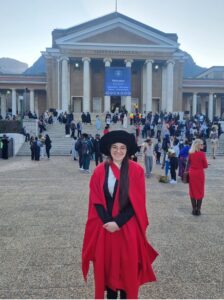 Dr. Annie Kok: In my thesis, entitled Dark Networks: A South African Cash-in-Transit Crime Case Study, I argue that to understand and disrupt organized crime, one must decipher the connectivity patterns among the people involved in its planning and execution. My doctoral thesis examined South African cash-in-transit criminal networks using a mixed-methods approach that combined network analysis and expert interviews, demonstrating the value of analytical methods in disrupting such networks. The main contribution of the research is the conceptualization of a CIT criminal network cycle that illustrates the progression of a CIT criminal cooperative throughout its duration. It also explores why the cash-in-transit criminal network cycle proves resistant to disruption in South Africa.
How did the Next Gen fellowship program impact your doctoral journey?
The fellowship impacted my journey by providing both academic and financial support. Most importantly, it enabled me to focus exclusively on my doctoral research project. Researchers will readily agree that uninterrupted research time is perhaps the greatest reward in academia; however, it also means spending extended periods alone with your data and thoughts, neither of  which are very cooperative companions beyond the midway point of your PhD journey. The doctoral journey is therefore often notoriously lonely. For this reason, another key benefit of the fellowship was the opportunity to be included in a large and vibrant academic community. It offered opportunities to travel and engage with like-minded scholars from across Africa, many of whom have since become friends. The fellowship not only permitted me to explore a delightfully unconventional topic but also to succeed in this endeavor. It was an absolute privilege.
Now that you have completed your PhD, what are your plans for the future?
All scholars hope to contribute to their fields beyond the academic project. Upon submitting the thesis, I was offered an opportunity to consult on a Global Initiative Against Transnational Organized Crime research project about organized crime in South Africa, which was the perfect transition from the PhD. I have since assumed the role of researcher for the South African Parliamentary Portfolio Committee on Police, which enables me to conduct research in an impactful environment. Alongside this role, I continue to work on publishing the findings from my doctoral research. Current manuscripts in progress include the following:
- “The Cash-in-Transit Criminal Network Cycle: A Conceptual Model of Organised Robbery Networks in South Africa”
- “Mapping a Cash-in-Transit Criminal Network: An Ex-Post Social Network Analysis of the KZN26 Robbery in South Africa”
- “A Sisyphean Task: The Challenge of Disrupting the Cash-in-Transit Crime Cycle in South Africa”
What advice do you have for upcoming doctoral students?
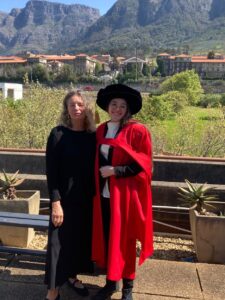 In my experience, networking, reading widely, and taking a break from time to time are key to a well-balanced and rewarding journey. Doctoral research is isolating, so I advise you to make a concerted effort to attend events (social and otherwise), particularly with other postgraduate researchers. You should attend seminars and conferences even if they are only remotely relevant to your work; not only does it support fellow researchers, but you will be surprised by the inspiration and ideas you will find in others’ work. Read, read, and read, but know when to stop – you cannot reasonably do justice to it all. While you are at it, take a moment to celebrate the small victories now and then (being a doctoral researcher is one of those victories). It is critically important to schedule a leave of absence to optimize your productivity. Working nonstop on the doctoral thesis quickly leads to diminishing returns. Finally, enjoy the process; it is a unique experience that is genuinely challenging, yet so rewarding.
Published Works
- Kok, A. and Van der Spuy, E., 2015. South African inquiries into policing: 1910-2015. South African Crime Quarterly, (53).
- Shaw, M., Collins, J. and Kok, A. forthcoming. Organised crime and illicit markets: understanding criminal connections between actors and economic forces. Oxford Handbook of Illegal Markets