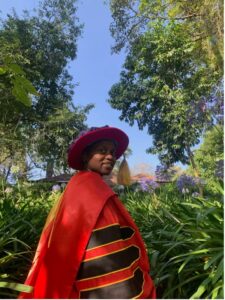
Dr. Nguye Flora Mutere is a multimedia designer, digital heritage researcher, and lecturer, teaching Interactive Media Design at the Department of Design and Creative Media at the Technical University of Kenya. She received the Next Gen doctoral dissertation proposal development fellowship grant for 2022-2023.
She is an alumna of The Smithsonian’s Institution African Museology Exchange Program in the U.S. Department of State’s Cultural Heritage Center (CHC) and the Smithsonian Institution’s National Museum of African Art (NMAfA) and Office of International Relations (OIR) Cohort 2023, Council for the Development of Social Science Research in Africa CODESRIA College of Mentors 2023 Laureate, and an ICOM CAMOC (Cities) Board member, where she co-ordinates the communications section. This is an international committee and global think tank on city museums and heritage matters. They define standards, develop recommendations, and share professional experience and scientific information with ICOM members.
Dr. Nguye holds a B.Ed in Fine Art (Kenyatta University), a Master of Arts in Computer Art (Savannah College of Art and Design), and a PhD in Design (Technical University of Kenya). She uses digital innovation, community engagement, and heritage preservation in developing community-centered approaches to cultural memory preservation.
Next Gen: Briefly describe the central argument of your doctoral dissertation. What is its main contribution to knowledge in your field?
The title of my PhD dissertation is The Future of Nairobi Railway Museum: Education and Decolonisation in the Digital Age. The central argument uses an Afro-feminist lens to unpack the inclusion of African memory from 1950 to 1970 in the Museum. Sitting at the intersection of a historical anthropology of the railroad and research-based development of multimedia educational design, this project developed appropriate solutions for decolonizing the Nairobi Railway Museum. The research focuses on black railroad workers from the 1950s to 1970s, who were the generation that resided in the city with their families. These working-class groups’ everyday lives were molded around the material construct of the railroad. The events and trends surrounding the railroad share common attributes due to their urban heritage and, to date, remain accessible through recollections and personal memorabilia, thereby supporting the rich development of narratives central to the study.
 The dissertation’s contribution to the field of digital heritage design is a curated collection of tangible and intangible items, providing intellectual and institutional access as a site of memory to which the feminine has been excluded within a collection. It is a visual sociological analysis of tensions of whose epistemes are centered, why, and what that means for Indigenous knowledge systems, marginal status, power, belonging, and identity in Nairobi, Kenya.
How did the Next Gen fellowship program impact your doctoral journey?
The writing and dissemination workshops shaped the quality of my academic output. The program offered targeted support in structuring scholarly articles, drafting compelling abstracts for conferences, and writing proposals persuasively for grants. The workshops improved my ability to structure arguments, integrate literature, and write for peer-reviewed journals. The iterative process of drafting, receiving feedback, and revising greatly improved my confidence and clarity as a scholarly writer. The mentorship provided by the facilitator and the peer-to-peer feedback loop were instrumental in refining my arguments and identifying areas for growth. The feedback dynamic challenged my positionality as a digital humanities researcher and helped me recognize blind spots in my writing. The facilitator’s insights on argumentation were transformative for my scholarly writing.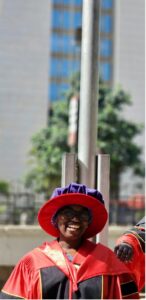
The workshops were a foundational part of my academic and professional development.
In summary, the Next Gen fellowship program provided:
- Improved clarity and coherence in academic writing
- Understanding of disciplinary conventions
- Experience with feedback and revision cycles
The fellowship afforded two exceptional opportunities for meetups and professional exchange at L’observatoire Art et recherche Casablanca, Morocco. These were opportunities to create vibrant networks through a professional exchange of experiences and research projects, in addition to the APN and Next Gen Writing and Dissemination Workshop, at the University of Ghana, Legon. Here is where rich heritage exploration and encounters at the National Museum and Ussher Fort visit increased my knowledge and awareness of cultural heritage and preservation on the continent.
Now that you have completed your PhD, what are your plans for the future?
The plan is to mobilize the study’s explicit outcomes into a well-crafted, immersive, and interactive storytelling display. By blending rich textures in sound and images, as re-enactments of well-preserved narratives on the origins of the city of Nairobi, using digital platforms, I will exhibit and display the narratives of the retired Railway workers who were the co-participants, both online and at physical locations, for public audiences. This reflects my approach to postdoctoral study and praxis, which curates an experience of the community’s cultural heritage to support the care and preservation of my research participants’ memories.
What advice do you have for upcoming doctoral students?
The PhD journey is like a long, intense hike: you choose to enjoy the surroundings while scaling the heights and focusing on the summit. You have chosen this path and experience knowing well that it will test your character, endurance, and resolve. The key to reaching the summit successfully, whole, and intact, is not just keeping your eyes fixed on the finish line. Also appreciating the terrain, the changing vistas, bonding with fellow candidates, and discovering your grit along the trail.
My advice would center on three principles:
Embrace the process, not just the outcome. The doctoral journey’s attrition rates are high. Do not become that statistic. Rather than crashing out due to immense challenges at different stages – the unexpected insights, the immersive detours in literature review, the definitive moments when concepts crystallize – allow yourself to authentically be curious about your research, not just mechanically fulfilling research obligations and targets.
Build your support network early. Conduct a relational inventory of your community as you progress. No one travels well alone; do not attempt this PhD hike in isolation. Cultivate relationships with peers who appreciate and understand the journey, which can be lonely, to provide support during the writing of dissertation chapters. Networking will enable you to find mentors who can guide and affirm you through treacherous sections. Maintain and protect connections outside academia that ground you. These relationships matter as much as your research skills and abilities.
Pace yourself and practice self-care. The maxim – your race and pace is highly accurate. There will be days when you question everything and everyone. When progress is slow, and the summit seems to grow ever distant (this was me when writing up the dissertation), despite your best efforts. Accept that rest is part of the journey. Adjust your pace when necessary. Celebrate the milestones and wins–completed chapters, acquiring funding, accepted proposals, coherent literature reviews, or methodology that works well.
Remember that you are not just earning a degree. You are levelling up as a scholar. The chrysalis takes time and, gradually, through countless steps, you gain elevation one footstep at a time. Trust the process and enjoy the journey, knowing that summitting will be rich and valuable because of all you experienced along the way.
A list of Nguye Flora Mutere’s published works:
N.F. Mutere. (2025). Book Review: A programme of absolute disorder: Decolonising the Museum by Françoise Vergès. Unsettling the City: Decolonial Approaches to Urban Memory and Museums. CAMOC Museum of Cities Review. Accessible at https://camoc.mini.icom.museum/wp-content/uploads/sites/4/2026/01/CAMOC-Review-Special-Decolonisation-2025.pdf
N.F. Mutere. (2024). Kenya’s ways of being in the city: Museums and heritage projects. What is a City Museum? Collecting within a city – CAMOC Museum of Cities Review. Accessible at https://camoc.mini.icom.museum/wp-content/uploads/sites/4/2024/09/CAMOC-Review-Summer-Fall-2024-F-web-1_compressed-1.pdf
N.F. Mutere. (2024). Never Forget! Cultural Production in Support of the June 2024 Maandamano. Jahazi Arts Culture Performance Journal. Twaweza Communications. Accessible at https://jahazi.co.ke/arts-digital-technology-the-gen-z-protests-in-kenya/
N.F. Mutere. (2022). Location, Location, Location – Barcelona: a living laboratory – CAMOC Museum of Cities Review. Accessible at https://camoc.mini.icom.museum/wp-content/uploads/sites/4/2022/06/CAMOCReview-No.1-2022-for-wbesite.pdf