President John Dramani Mahama’s recent state visit to Zambia produced an unexpected flashpoint: not on trade or security cooperation, but about his attire. He arrived in Lusaka wearing a traditional Ghanaian smock known as the fuguor batakari, a handwoven garment deeply rooted in the culture and heritage of northern Ghana. As images of him circulated widely online, they were followed by Zambian social media commentary likening the garment to a ‘blouse’ and questioning whether he had borrowed it from his wife, Mrs. Lordina Mahama.


The backlash from Ghana was immediate and emotionally charged. Ghanaian travel content creator Wode Maya publicly condemned the comments, calling them disrespectful and clarifying that the outfit was traditional Ghanaian attire, not women’s clothing.1 Coverage quickly migrated from social media into mainstream platforms, amplifying outrage and counter-outrage. In parallel, some Ghanaian commentary framed the episode as an opportunity to ‘school Zambians’ on Ghanaian culture,2 shifting the tone from explanation to competitive cultural nationalism.
It is tempting to dismiss the incident as just another episode of social media drama. But there are important lessons for peacebuilding audiences and practitioners about cultural diplomacy, identity, and the role of social and traditional media in shaping public discourse across Africa. The first lesson is that cultural conflict disrupts but also creates, as it converts tension into cultural pride, as seen in Ghana’s declaration of Wednesdays as “fugu day.”3
Infrastructures of dignity
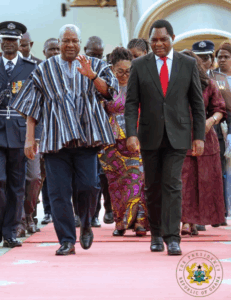
The intense reaction to the ‘blouse’ label was not about fashion: it was about the layered linguistic and semantic codes of status, masculinity coding, colonial memory, and cultural legitimacy embedded in the word and the way it was deployed. Traditional attire, especially on a head of state, is never just clothing. It is a political statement of national pride; an aesthetic argument that in a postcolonial world, African modernity need not distance itself from its cultural history. When African leaders foreground traditional wear in diplomatic settings, it helps normalize African authority in African terms, which matters not only diplomatically but also psychologically, shaping how societies see each other outside formal politics.4 This matters on an internal and external scale. Domestically, it builds cultural confidence. Regionally, it signals authenticity. Globally, it challenges residual colonial assumptions about what leadership should look like.
Peacebuilding frameworks often measure risk in terms of weapons flows, electoral volatility, or economic shocks. But grievance formation often begins somewhere quieter: perceived disrespect, symbolic humiliation, or the suggestion that one group’s cultural expression is unserious, backward, or ridiculous. Dignity operates like emotional infrastructure; when it cracks, political stability rarely remains untouched.
Cultural difference matters to Pan-African relations
The fugu episode also exposed something structurally important: African states do not share identical relationships to traditional clothing in both everyday and political life. States like Ghana, Nigeria, and South Africa have deeply institutionalized indigenous ceremonial aesthetics in leadership imagery. Others historically default to Western formal wear in statecraft, reflecting colonial administrative legacies, missionary influence, or post-independence state formation choices. Problems emerge when one cultural grammar is unconsciously universalized. What signals authority in Tamale may convey unfamiliarity in Lusaka. Likewise, what is gender-neutral in one tradition may be read as gender-coded elsewhere. Pan-African unity is often imagined as simply existing because of shared history. In reality, it is a process dependent on learning how to understand differences without turning them into competition. Interculturality is not just about celebrating diversity, but also about learning how to read each other properly.
Media narratives are not passive observers of conflict risk5
The ‘blouse’ comments were provocative and derisive. However, the moment some Ghanaian coverage moved from explaining culture to ‘schooling’6 Zambians, the temperature changed. What could have been a moment of mutual learning started to sound like a cultural scorecard. Cultural exchange works best when it is grounded in curiosity. The moment it is framed as correction or superiority, it risks turning cultural difference into hierarchy, eventually curdling into resentment.
History offers sobering reminders about how media narratives can evolve from framing tools into conflict triggers. During the 1994 genocide in Rwanda, media outlets such as Radio Télévision Libre des Mille Collines did not merely report tensions; they helped construct identity boundaries, amplify fear, and normalize violence through repeated narrative reinforcement.7 The International Criminal Tribunal for Rwanda later convicted senior media figures for direct and public incitement to genocide, recognizing media as an active conflict actor rather than a neutral mirror.
The point is not that wardrobe disputes lead to war, but that narratives are ecosystems that grow, mutate, and accumulate emotional sediments. Peacebuilders ignore early narrative distortions at their own risk.
Social media: The fastest escalator ever built
If traditional media sets the tone of a story, social media can cause it to explode overnight. A single comment can now cross borders, languages, and audiences before diplomatic channels have time to put their shoes on. Unfortunately, nuance has no real way of catching up with how fast outrage travels: by the time it arrives, outrage is already everywhere.
The Ghana–Zambia exchange shows how quickly symbolic issues can become continental identity conversations. It also shows how quickly correction becomes secondary once emotions take hold, particularly online, where what feels immediate and certain tends to travel further than what is careful or complex. The problem is that culture rarely exists in simple, easily shareable forms; it lives in context, memory, and layered meaning, which makes it vulnerable to being misread in fast-moving digital spaces.
Cultural diplomacy is preventive peace architecture
Cultural diplomacy, a contested concept that lacks an accepted scholarly definition8, is still often treated as decorative; something that sits on the edges of ‘real’ foreign policy.9 This marginalization reflects broader tendencies in African contexts, where public and cultural diplomacy remain comparatively underexplored and weakly embedded in foreign policy frameworks.10 Yet culture is usually where recognition between societies is first felt and tested. Because cultural signals are so visible, they shape how ordinary people see each other long before disagreements ever show up at the level of policy. For peacebuilders, that makes culture less a symbolic space and more an early layer of relationship-building, where trust or resentment can begin to take root.
By foregrounding traditional wear in a diplomatic setting, President Mahama was not just signaling identity or symbolism. He was anchoring authority in African cultural terms. This matters because interstate relationships are not built only through agreements between governments, but also through how societies perceive respect, dignity, and legitimacy in each other. In that sense, cultural signaling can support trust-building long before crises require formal diplomacy.
Africa has drawn on culture as connective political tissue before. The Second World Black and African Festival of Arts and Culture (also known as FESTAC ’77) was not nostalgia; it was geopolitical imagination expressed through culture, creating psychological bridges across linguistic, colonial, and regional divides.11 At a time when continental integration is often discussed in terms of trade corridors and regulatory alignment, cultural diplomacy remains a significant part of the emotional infrastructure that makes integration feel credible and sustainable, rather than purely transactional.
Pointers for peacebuilders
Several implications stand out.
First, treat cultural literacy as a core peacebuilding capacity, not a soft add-on.12 Diplomatic and peacebuilding training needs to include intra-African cultural competence, not just global protocol. Misunderstandings between neighbors can escalate as quickly as misunderstandings with external actors.
Second, recognize media and digital actors as part of the peacebuilding landscape. Narrative framing is never neutral; how cultural difference is explained, derided, or sensationalized can shape cross-border perceptions and political relationships over time.
Third, widen preventive peacebuilding to include symbolic risk.13 Many conflicts do not begin with violence, but with narratives about disrespect, exclusion, or cultural hierarchy. Monitoring those signals early is part of prevention and not a distraction from it.
Finally, peacebuilding must engage seriously with information environments. That means not only responding to false claims but understanding how cultural symbols can be stripped of context, simplified, and redeployed as tools for identity mobilization.14
Peace Begins in Meaning
The fugu story reflects the larger problem of how narratives of disrespect travel, how they harden into identity claims, and how quickly a seemingly harmless comment becomes a referendum on dignity. When cultural symbols are involved, the stakes are steeper, precisely because culture is rarely only about culture: it also invokes history, hierarchy, gender coding, and the long shadow of whose ways of being are considered proper in public life.
Africa’s diversity is often discussed as something to be managed. But it is just as often identified as a source of strength,15 even if it asks a lot of us in return. It asks for interpretation, patience, mutual respect, and a certain humility in how we understand each other. If Africa is serious about building durable peace, it must pay attention not only to borders and economies, but also to meaning: how people see themselves and how they feel they are seen by others. People are less likely to mobilize around trade figures than around how they feel seen, valued, or disrespected.16 And dignity, more often than we admit, is sometimes worn before it is spoken.
Endnotes
- Wode Maya, Facebook post, https://www.facebook.com/Wodemaya/posts/just-woke-up-reading-disgusting-comments-from-zambians-calling-fugu-blousei-keep/1461936535293425/.
- “Wode Maya Slams Zambians for Describing Mahama’s Fugu as ‘Blouse’,” Citi Newsroom, February 2026, https://citinewsroom.com/2026/02/wodemaya-slams-zambians-for-describing-mahamas-fugu-as-blouse/.
- “Zambians Schooled on Ghana’s Fugu,” The High Street Journal, https://thehighstreetjournal.com/zambians-schooled-on-ghanas-fugu/.
- Louisa Osei, “Ghana Declares Wednesdays as National Fugu Day,” Citi Newsroom, 2026, https://citinewsroom.com/2026/02/ghana-declares-wednesdays-as-national-fugu-day/.
- [Author Unknown], “Lex Localis Article,” Lex Localis, 2026, https://lex-localis.org/index.php/LexLocalis/article/download/65-89/5-90/27277.
- “Media as a Peace Builder: Conflict Resolution Narrative,” The Law Institute, https://thelaw.institute/application-of-ihl/media-peace-builder-conflict-resolution-narrative/.
- “Rwanda: Historical Background,” United Nations, https://www.un.org/en/preventgenocide/rwanda/historical-background.shtml.
- Natalia Grincheva, “The Past and Future of Cultural Diplomacy,” International Journal of Cultural Policy 30, no. 2 (2024): 172–91. https://doi.org/10.1080/10286632.2023.2183949.
- Ibid.
- Isaac Antwi-Boasiako, “African Governments’ Foreign Publics Engagement: Public Diplomacy in African Perspective,” African Journal of Economics, Politics and Social Studies 1, no. 1 (2022): 1–12.
- African Union, The Contribution of Arts, Culture and Heritage to Sustainable Peace (Concept Note, 2021), https://au.int/sites/default/files/newsevents/conceptnotes/41121-CN-Concept_note_1_-_The_contribution_of_arts_culture_and_heritage_to_sustainable_peace.pdf.
- “The Role of Cultural Diversity in Conflict Resolution in Africa,” Ideas for Peace, https://ideasforpeace.org/content/the-role-of-cultural-diversity-in-conflict-resolution-in-africa/.
- “Cultural Diversity and Conflict Resolution,” RSIS International, https://www.rsisinternational.org/journals/ijriss/Digital-Library/volume-3-issue-12/194-204.pdf.
- “PATH: Peacebuilding Assessment Tool for Heritage Recovery and Rehabilitation,” ICCROM, https://www.iccrom.org/sites/default/files/publications/2021-03/path_final_9.3.21.pdf.
- “The Contribution of Arts, Culture and Heritage to Sustainable Peace,” African Union, https://au.int/sites/default/files/newsevents/conceptnotes/41121-CN-Concept_note_1_-_The_contribution_of_arts_culture_and_heritage_to_sustainable_peace.pdf.
- “African Approaches to Building Peace and Social Solidarity,” ACCORD, https://www.accord.org.za/ajcr-issues/african-approaches-to-building-peace-and-social-solidarity/.