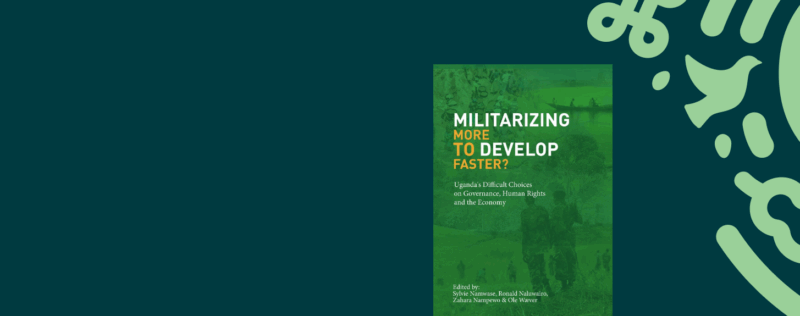
Militarizing More to Develop Faster? examines the militarization of various sectors of Uganda’s political, social and economic spheres, in relation to national development. The book is a product of a research project undertaken at the eve of the Covid-19 global pandemic, focused on the impact of President Museveni’s Operation Wealth Creation (OWC) launched in 2017, on Uganda. The project examined the impact of militarization, particularly the Ugandan military’s involvement in different sectors of the economy, politics and society. Chapter one introduces the rationale, framework and the methodologies of the volume. It situates the book within the historiography and political economy of the militarization of state-led development in Uganda and beyond.
Chapter two examines the ideological dimension of governance in Uganda under President Museveni. Chapter three explores the militarization of Uganda’s police. The fourth chapter delves into the militarization of the local fish industries while the chapters that follow focus on the militarization of wildlife conservation and agriculture, respectively. Chapter seven evaluates the nature of participation in the OWC project. Using the case of the National Resistance Movement (NRM), chapter eight explores ‘parliamentary oversight in the age of militarization’ in Uganda. The penultimate chapter of the book introduces readers to precarity, gender dimensions, resistance and survival of the majority of the people in society in a phase of militarization of development. The last chapter reflects on the paradoxes of future prospects beyond militarization.
The book interrogates the assumption that President Museveni’s regime, which has been in power since 1986, privileges the military as a more efficient institution for delivering development goals at the national level. It is anchored on two major interrelated objectives, one short-term and the other long-term. The former objective is to assess whether development interventions driven by militarization have worked, or not. The latter objective is directly connected to the Sustainable Development Goals (SDGs), in particular the SDG 16. It explores the impact of militarized development interventions on socio-economic, political, environmental and gender relations with a view to assessing how militarized development impacts on the “future of peace, justice and strong institutions.” As a result, the book is interdisciplinary at its core, and foregrounds various explorations of the topic with relevant historical antecedents.
A lot of good things can be said about the book and the individual chapters; however, in this review, I will focus on the merits of how the book is conceptualized, and what it implies for Uganda and beyond. The renowned economic historian, Gareth Austin (2013), used the concept of “reciprocal comparison” to advance that contrary to dominant Eurocentric stereotypes, various lessons can be drawn from Africa to inform the rest of the world. In this volume, different chapters emphasise a particular “ethno-military economic power,” which delivers incidental benefits while weakening various civilian institutions, contributes to inequality and poverty, marginalization of the locals and small-scale industries. It also shows how militarization produces new power asymmetries and exclusive networks of accumulation, which prioritize the elites and corrupt military officials. One wonders, is militarization only a Ugandan feature? Is not neoliberal capitalism and the contemporary post-Covid-19 pandemic highly militarized in different forms? Ideologically, the goals achieved have in them what Keith Hart (2005) calls the ‘hitman’s dilemma;’ “it is not personal, it is business.” Its socio-economic impact is that people are marginalized and pushed aside. At the end, who can argue against certain benefits of wildlife protection and increased fish populations? But in this, we see the continuation of what Robert Nelson (2003) aptly labelled as the colonial environmental ideology of ‘saving Africa from Africans.’
For the authors, therefore, the explanation as to what militarized development does is not straightforward. To use Hegelian dialectics, it lays not within the binary of the positives and negatives of militarized initiatives; but in understanding normative frames and regimes (see, Beraldo 2023) of social order and control as encapsulated in the ideology and consciousness of militarization as a ‘ruling idea’ – a greater synthesis. In essays that came to be known as the German Ideology, Karl Marx and Friedrich Engels to forth the “…first document of dialectical-materialist philosophy of society and its history” (Kopf as cited in Carver and Blank 2014: 1). In Uganda, therefore, militarized development acts as a dominant coercive ideology. In this regard, Oloka-Onyango (p.249) asserts that “…power represents the basic value of militarism and posits the military as an exaggerated microcosm of this dominance protecting those in control of the state” in Museveni’s Uganda.
Victorian capitalism and nation-states, later, emerged in Europe as liberal expressions of a new order, which replaced the Old Regime — divine kings who used superstition and religiosity to enforce social order and control. One of the dominant outcomes of these intellectual traditions was the emergence of a ‘civil society,’ which Hegal constructed as a sphere of individual interests between the personal and impersonal realms of society. Marx and Engels, instead, argued that the idea of a ‘civil society’ embraces the material basis of individuals and transcends the state and the nation. This exclusive culture “…only develops with the bourgeoises; the social organization evolving directly out of production and commerce, which in all ages forms the basis of the State and of the rest of the idealistic superstructure….”1
Colonialism imposed these elitist ideologies and performances of statecraft, which post-independence ruling elites are entangled. In this regard, chapter two of Militarizing More to Develop Faster, correctly refers to Mamdani’s classic book, Citizens and Subjects. The elites are to be listened to, and the ordinary people are systematically marginalized in grand development pursuits. The prospects for demilitarization might be bleak; but “…the only challenge to militarism and militarization is resistance, which can only be mustered through the consolidation of political power and popular voice,” advances Oloka-Onyango (p.273). Among others, chapter ten argues that the obscured historic role of women in national politics must be understood as a significant factor in countering militarized and toxic politics framed along patriarchy and hyper-masculinity to build a meaningful democracy. As chapter nine demonstrates, people are not passive victims that willingly subscribe to imposed doctrines. They act proactively to survive, and ‘speak truth to power’ through the women’s-led protests.
References
Austin, G. 2013. “Reciprocal Comparison and African History: Tackling Conceptual Eurocentrism in the Study of Africa’s Economic Past,” African Studies Review, 50(3), pp. 1-28.
Beraldo, A. 2023. “The Social Dynamics of Violence and Respect: State, Crime and Church in a Brazilian Favela”, Journal of Latin American Studies, 55, pp. 27-49.
Carver, T and Blank, T. 2014. A Political History of the Editions of Marx and Engels’s “German Ideology Manuscripts”. New York: Palgrave MacMillan.
Hart, K. 2005. The Hit Man’s Dilemma: Or Business, Personal and Impersonal. Chicago: Prickly Paradigm Press.
Mamdani, M. 1996. Citizen and Subject: Contemporary Africa and the Legacy of Late Colonialism. Princeton: Princeton University Press.
Marx/Engels Internet Archive, 2000. https://www.marxists.org/archive/marx/works/download/Marx_The_German_Ideology.pdf, accessed on 23 September 2025.
Nelson, H. R. 2003. “Environmental Colonialism: “Saving” Africa from Africans”, The Independent Review, viii (1), pp. 65-86.
Endnotes
-
Marx, Karl, and Friedrich Engels. The German Ideology. Accessed September 23, 2025. https://www.marxists.org/archive/marx/works/download/Marx_The_German_Ideology.pdf.