Introduction
Global climate change poses a profound threat to the right to a clean and healthy environment, intensifying conflict, displacement, food insecurity, poverty, biodiversity loss, and ecological degradation. These negative impacts are disproportionately borne by Africa despite the continent’s negligible contribution to global greenhouse gas emissions. This stark injustice exposes a deeper epistemic problem: dominant global environmental discourses continue to privilege anthropocentric and technocratic models rooted in Western modernity while marginalizing Indigenous ecological knowledge systems.¹
The anthropocentric worldview underpinning Western capitalism and colonial expansion elevates human interests above the integrity of the natural world.2 Exported through colonial governance, missionary education, and development paradigms, this worldview displaced Africa’s relational ecological traditions and redefined land, forests, and rivers as exploitable resources. Contemporary global environmental governance—largely shaped by OECD institutions—still reflects this epistemic hierarchy, often overlooking culturally grounded ecological ethics that have historically sustained African landscapes. As African development scholars such as Ake and Mkandawire argue, the persistence of externally driven policy frameworks has weakened local ownership and undermined indigenous knowledge systems.3
This article contends that Africa’s ecological crisis is inseparable from this colonial epistemic rupture. The erosion of indigenous environmental ethics has disrupted long-standing moral relationships between communities and ecosystems. Yet these traditions endure, offering alternative ecological imaginaries capable of informing just and sustainable futures. To demonstrate this, the study examines the indigenous environmental ethics of the Ethiopian Orthodox Tewahedo Church (EOTC) on the Zeghie Peninsula of Lake Tana. Drawing on qualitative ethnography—interviews, focus groups, and participant observation—it analyzes how religious narratives, monastic rules, and everyday practices produce a deeply embedded conservation ethos rooted in the teachings of the fourteenth-century Saint Abune Betre Mariam.
Findings show that prohibitions against plowing, grazing, and tree cutting are not merely customary regulations, but moral obligations grounded in theological interpretations of creation. Through ritual practice, spiritual guardianship, and the sacralization of forest spaces, these ethics have been transmitted across generations. The Zeghie forest thus emerges as a moral ecology in which biodiversity conservation is inseparable from cosmology, identity, and spiritual belonging. The study argues that EOTC monastic traditions articulate a historically rooted ecocentric philosophy that challenges dominant anthropocentric environmental governance. Long before environmental ethics emerged in Western academia in the 1970s, EOTC teachings cultivated sustainable human–nature relations grounded in sacred interdependence. Recognizing such traditions dismantles Eurocentric assumptions that deny Africans intellectual authority in shaping environmental thought and governance.
Ecocentric Environmental Ethics for a Just and Sustainable Future
Environmental ethics underpin the moral relationship between humans and the non-human world. Since its institutional emergence in Western scholarship in the 1970s, the field has been structured around a central tension between anthropocentrism and ecocentrism.4 Anthropocentrism positions humans as the primary locus of value, interpreting nature mainly through its utility.5 Embedded in industrial capitalism and technocratic development, this perspective has fueled ecological degradation while failing to resolve it. Environmental governance frameworks derived from this paradigm frequently.6
Ecocentrism offers a fundamentally different orientation. It recognizes intrinsic value in ecosystems, species, and ecological processes, situating humans within—rather than above—the community of life.7 Ecocentric ethics therefore call for sustainability approaches that integrate indigenous ecological knowledge, cultural values, and place-based practices.8 Increasingly, scholars and practitioners acknowledge that durable environmental governance must be culturally grounded and ethically relational. Across Africa, many indigenous worldviews have long embodied such ecocentric orientations.9 Humans are understood as participants in a living cosmos linking ancestors, spirits, landscapes, and biotic communities.10 These traditions challenge the assumption that ecocentric thought is a modern Western innovation and instead reveal it as a longstanding feature of African ecological philosophy.
Colonial Ecology and the Reclamation of African Ecological Wisdom
Colonialism did not merely transform African economies and polities; it reconfigured ecological consciousness.11 Eurocentric narratives portrayed African environmental knowledge as primitive while legitimizing extractive land use and optimal resource exploitation.12 Forests became timber reserves, rivers hydroelectric assets, and landscapes sites of agricultural or mineral production. Such transformations fractured relational ecological systems that had previously regulated human–nature interactions.
In contrast, many African cosmologies conceive reality as an interconnected community of life forces encompassing humans, ancestors, spirits, animals, plants, and landscapes. Harmony among these forces sustains cosmic balance. Thinkers such as Senghor described the universe in African metaphysics as an interwoven network of vital energies emanating from and returning to the divine source.13 Nature is therefore not inert matter, but a morally significant presence.
This relational ontology persists across diverse African traditions—from Ubuntu ecological philosophy in southern Africa to Yoruba sacred ecology in West Africa14 and the church-forest traditions of Ethiopia.15 These systems encode conservation ethics within spiritual and social norms, regulating resource use through moral obligation rather than external enforcement. As plausibly demonstrated by an African environmental ethicist16 and reiterated by the priests as informants from Zeghie Peninsula, the common maxims of the indigenous ecological ethos found in various African communities emphasize unity and harmony among all creations and the entire ecosystem. This stands in sharp contrast to the hierarchical and exploitative traditions that characterize the anthropocentric ecological discourse, which forms the foundation of Western intellectual and industrial capitalism. Reclaiming this indigenous ecological wisdom is not merely an exercise in cultural nostalgia; it is a decolonial imperative. This approach re-centers African epistemologies in environmental governance and suggests that sustainable futures may rely less on importing external models and more on revitalizing suppressed ecological philosophies.
Indigenous Environmental Ethics of the Ethiopian Orthodox Tewahedo Church
The Ethiopian Orthodox Tewahedo Church preserves one of Africa’s most enduring ecocentric traditions. The Ethiopian Orthodox Tewahedo Church (EOTC) is one of the oldest Christian churches in the world and the largest Oriental Orthodox Church in Africa. Rooted in Ethiopia’s ancient civilization, it has profoundly shaped the country’s spiritual life, culture, literature, and identity. Christianity was introduced to the Kingdom of Aksum in the 4th century through the missionary work of Frumentius, who was later consecrated as bishop by Athanasius of Alexandria. King Ezana adopted Christianity as the state religion, making Aksum one of the earliest Christian states. For centuries, the EOTC was administratively linked to the Coptic Church of Egypt under the Patriarch of Alexandria. It became fully autocephalous (self-governing) in 1959 when the first Ethiopian patriarch, Abuna Basilios, was enthroned.17 The term “Tewahedo” (Geʽez: ተዋሕዶ) means “being made one,” which refers to the Church’s Christological doctrine of the unified divine and human nature of Christ. Thus, the Ethiopian Orthodox Tewahedo Church is an ancient, indigenous Christian tradition characterized by its unique Christology, expanded scripture, monastic spirituality, and deep integration with Ethiopian culture and history. The ecocentric teachings and practices of the EOTC are most evident on the Zeghie Peninsula of Lake Tana, often referred to as Ethiopia’s “Little Amazon,” as partially demonstrated in the following picture:
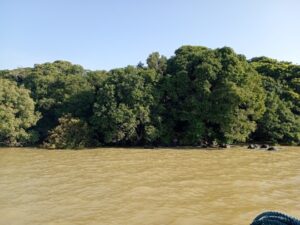
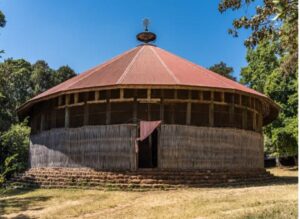
This study was conducted on the Zeghie Peninsula of Lake Tana in Northwestern Ethiopia. The peninsula is located within the satellite neighborhood of Bahir Dar city, approximately 595 km from Addis Ababa and 30 km from Bahir Dar. According to the 1999 E.C. Population and Housing Census, Zeghie is home to 7,634 residents, comprising 3,581 men and 4,053 women, predominantly from the Amhara ethnic group and adherents of the EOTC, with a small Muslim minority. The peninsula was purposively selected for its dense forests and the presence of nine historic churches: Mehal Zeghie (14th century), Betre Mariam (14th century), Aziwa Mariam (17th century), Kidane Mihiret (17th century), Debre Sillassie (17th century), Washa Medhanealem (17th century), Fire Mariam (17th century), Tekle Haymanot (17th century), and Yiganda Rufael (21st century). These churches are renowned for preserving the ecological teachings of Abune Betre Mariam and provide an exemplary context for studying the intersection of religious practice and environmental conservation. Thus, the survival of the peninsula’s dense forests and historic monasteries can be attributed to the sacred conservation norms established by Abune Betre Mariam in the fourteenth century.
Zeghie Peninsula’s Sacred Forests and Ecocentric Cosmology
The biodiversity of Zeghie Peninsula and the ecocentric teachings of Abune Betre Mariam are inseparable. According to the Chronicle of Abune Betre Mariam and local informants—most of whom are priests and administrators of various churches on the Zeghie Peninsula—Abune Betre Mariam was born on August 24, 1332, in the Ethiopian Calendar (EC), to Tekele Mariam and Elaria in Sebila, a small village in North Shewa. His parents were devout Christians who fervently prayed for a child. During his adolescence, Abune Betre Mariam traveled extensively among monasteries to fulfill his religious duties. He later moved from Shewa, his birthplace, to Beghemider, where he remained for six years, delivering spiritual guidance. Following that, he traveled to the vicinity of Lake Tana, home to the Zeghie Peninsula, to perform religious services, preach, conduct baptisms, and care for the sick. In this context, a 63-year-old priest in Mehah Zeghie Georges explained:
When Abune Betre Mariam left his home, he only had his stick made of buckthorn (Gesho) Betre. With Saint Michael’s support, Abune Betre Mariam traveled to Zeghie, specifically to Daga Estifanos. He then crossed Lake Tana on an axle referred to by locals as ‘ዘንጌ’ in order to reach Zeghie. After witnessing such miracles, the monks at Zeghie asked Abune Betre Mariam how he crossed the lake. He explained that he used his axle, called ‘ዘንጌ’ or Zenge in the area, as a boat. According to local informants, Zenge eventually evolved into ዘጌ (Zeghie), the current name of the Peninsula (Interview with a 63-year-old male priest at Mehal Zeghie, 12/09/2025).
Abune Betre Mariam is recognized as the pioneer in the establishment of the Ethiopian Orthodox Tewahido Church (EOTC) sites on the Zeghie Peninsula and is widely associated with the Peninsula’s distinctive ecological worldviews and practices within the broader eco-friendly teachings of the EOTC. While many EOTC monasteries across Ethiopia have played vital roles in preserving natural forests in collaboration with various stakeholders, the ecological legacy of the Zeghie Peninsula is predominantly attributed to Abune Betre Mariam. Based on the Chronicle of Abune Betre Mariamand supported by interviews, focus group discussions, and documentary sources, it is plausible to argue that Abune Betre Mariam remains a seminal figure in the spirituality, forest conservation, and cultural life of the Zeghie Peninsula. His miraculous journey across Lake Tana, his monastic dedication, and his guidance of local communities underscores his lasting influence on the region’s religious and ecological heritage.
In Zeghie, forest conservation is not a technical intervention but a spiritual vocation.18 Abune Betre Mariam framed the forest as sacred space integral to divine creation. Humans, plants, animals, and landscape form a moral community ordered by God. Biblical interpretations emphasizing stewardship reinforce this ethic, portraying Zeghie as a living Eden where coexistence with nature expresses faith.
Monastic traditions further institutionalize this cosmology. The Geʿez concept gedam—forest as wilderness sanctuary—embeds ecological withdrawal at the heart of spiritual life. Trees surrounding churches symbolize divine presence, and harming them is morally inconceivable.19 Conservation thus emerges as an act of devotion, sustained through internalized belief rather than external regulation. This sacred ecology demonstrates that effective conservation may depend as much on moral meaning as on policy instruments. Ignoring such spiritual frameworks risk overlooking the ethical foundations that have preserved forests for centuries.
Faith-Based Biodiversity Conservation
Abune Betre Mariam’s covenant prohibiting plowing, livestock rearing, and tree cutting established a durable conservation regime. These prohibitions remain widely observed, ensuring the persistence of dense forest and rich biodiversity across the peninsula.20 Unlike surrounding deforested highlands, Zeghie retains continuous tree cover and habitat complexity. Livelihood systems adapted to these constraints emphasize coffee, gesho, citrus, fisheries, and artisanal production rather than agriculture. Community belief holds that adherence to the covenant secures divine protection and ecological balance. Faith-based norms thus function as effective informal environmental governance, demonstrating that conservation can be sustained through moral authority rather than legal enforcement.21 The Zeghie landscape—monasteries embedded within Eden-like forest—provides refuge for endemic species and stand as a living example of sacred-landscape conservation. It illustrates how spiritual values can regulate resource use and maintain biodiversity over centuries.
4.3 Intergenerational Justice and Sacred Stewardship
The ecological teachings of Abune Betre Mariam also embody intergenerational environmental justice. By restricting extractive land use and preserving forest integrity, Zeghie communities safeguard ecological inheritance for future generations.22 Conservation is understood as a covenantal duty linking ancestors, present communities, and future descendants. Protection of large indigenous tree species—such as Podocarpus, Cordia, Ficus, and Millettia—reflects this ethic. These trees are revered by the residents of Zegie Pensual as dwellings of ancestral spirits and as sources of ecological and social well-being. Consequently, cutting them down is considered morally prohibited. This sacred status serves as a long-term conservation mechanism, sustaining biodiversity while reinforcing cultural identity. The Zeghie case demonstrates how faith-based customary governance can institutionalize intergenerational accountability. Environmental stewardship becomes a sacred obligation rather than a regulatory burden, integrating ecological sustainability with spiritual continuity.
Conclusion: Toward a Decolonial Ecological Future
The ecological crisis in Africa cannot be understood solely as a technical or economic problem; it is also an epistemic and moral rupture produced by colonial ecological discourse. By displacing indigenous environmental ethics, colonial modernity disrupted relational human–nature systems that had long sustained African landscapes. The Ethiopian Orthodox Tewahedo Church’s sacred forest tradition demonstrates that alternative ecological paradigms endure. Rooted in ecocentric cosmology, moral obligation, and intergenerational stewardship, the Zeghie model challenges dominant anthropocentric governance and reveals the conservation potential of indigenous religious environmental ethics. This serves as a crucial entry point for deconstructing the anthropocentric discourse that dominates global discussions, thereby contributing to decolonial environmental ethics and countering Eurocentrism by integrating this indigenous African ecocentric perspective into global scholarship. This approach offers viable solutions to support the UN Sustainable Development Goals (SDGs).
Deconstructing colonial ecology requires more than critique; it demands the recognition and revitalization of indigenous ecological philosophies as legitimate foundations for environmental governance. Integrating these traditions into sustainability policy can foster conservation strategies that are culturally grounded, ethically relational, and socially legitimate. However, Ethiopia’s public policymaking still faces significant obstacles in deliberately navigating indigenous ecological worldviews. This challenge is a shared and pressing limitation of policy ownership across many African countries, as Ake (2001) plausibly explains.
Rather than directly emulating external development models, which often create confusion in public policy agendas, African public policy discourses should challenge the institutional, anthropocentric, and top-down global ecological debate by exploring local and indigenous solutions to the growing threats of climate change. Consequently, the path toward a just and sustainable future for Africa may lie not in adopting external environmental models but in reclaiming and rearticulating its own ecological wisdom. In this context, the sacred forests of Zeghie serve as a living testament that enduring sustainability emerges when nature is viewed not merely as a resource to be managed, but as a sacred community to which human beings belong.
Endnotes
- Kelbessa, W. (2012). Environmental injustice in Africa. Contemporary Pragmatism, 9(1), 99.
- Ramose, M. B. (1999). African philosophy through Ubuntu.
- Ake, C. (2001). Democracy and development in Africa. Bloomsbury Publishing USA; Mkandawire, T. (2004). Can Africa have developmental states. Making the international: economic interdependence and political order, 291-329. .
- Attfield, R. (2014). Environmental ethics: An overview for the twenty-first century.
- Kelbessa, W. (2012). Environmental injustice in Africa. Contemporary Pragmatism, 9(1), 99.
- White Jr, L. (1967). The historical roots of our ecologic crisis. Science, 155(3767), 1203- 1207.
- Regan, T., & Singer, P. (1989). Animal rights and human obligations.
- Kelbessa, W. (2012). Environmental injustice in Africa. Contemporary Pragmatism, 9(1), 99.
- Dixon, V. (1976). World views and research methodology. African philosophy: Assumptions and paradigms for research on Black persons, 51-100.
- Ikuenobe, P. A. (2014). Traditional African environmental ethics and colonial legacy. International Journal of Philosophy and Theology, 2(4), 1-21.
- ibid
- Kelbessa, W. (2012). Environmental injustice in Africa. Contemporary Pragmatism, 9(1), 99.
- Senghor, L. S. (2023). Negritude: A humanism of the twentieth century. In Imperialism (pp. 220-229). Routledge.
- Bẹwaji, J. A. I. (2018). Yorùbá values and the environment. Yoruba Studies Review, 3(1), 1-21.
- Woldemedhin, T., & Teketay, D. (2016). Forest conservation tradition of the Ethiopian Orthodox Tewahdo Church: a case study in West Gojjam Zone, north-western Ethiopia. Symbolae Botanicae Upsalienses, 38, 57-73.
- Kelbessa, W. (2012). Environmental injustice in Africa. Contemporary Pragmatism, 9(1), 99.
- The Ethiopian Orthodox Tewahido Church got opportunities and faced challenges after it secured its own patriarchate; Abune Basilios became the first Ethiopian Patriarch in 1959. Because of the promotion of the Ethiopian church to a patriarchate, it was possible to appoint bishops to different dioceses who know the language and the culture of the people. This was the greatest achievement to the church, which was suffering from the shortage of priests. The gold and different gifts that the church used to send to the Islamic leaders of Egypt and the pleadings it used to make to get a patriarch consecrated became history. Many churches were constructed in America, West Indies and Europe. After the death of Abune Basilios, Abune Tewoflos was appointed Patriarch of the church.
- Woldemedhin, T., & Teketay, D. (2016). Forest conservation tradition of the Ethiopian Orthodox Tewahdo Church: a case study in West Gojjam Zone, north-western Ethiopia. Symbolae Botanicae Upsalienses, 38, 57-73.
- Eshete, A. W. (2007). Ethiopian church forests: opportunities and challenges for restoration. Wageningen University and Research.
- Boylston, T. (2012). The shade of the divine: approaching the sacred in an Ethiopian Orthodox Christian community (Doctoral dissertation).
- Woldemedhin, T., & Teketay, D. (2016). Forest conservation tradition of the Ethiopian Orthodox Tewahdo Church: a case study in West Gojjam Zone, north-western Ethiopia. Symbolae Botanicae Upsalienses, 38, 57-73.
- Eshete, A. W. (2007). Ethiopian church forests: opportunities and challenges for restoration. Wageningen University and Research.