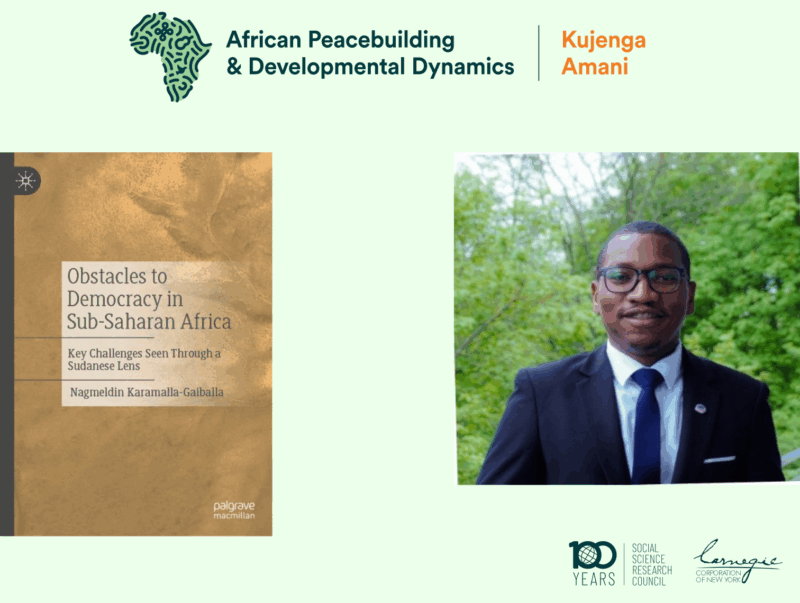
“Obstacles to Democracy in Sub-Saharan Africa: Key Challenges Seen Through a Sudanese Lens” offers a sustained and well-grounded interrogation and analysis of the structural, historical, and socio-economic constraints that continue to impede democratic consolidation across Sub-Saharan Africa. Anchored in Sudan as a principal case study, the book situates national political trajectories within wider theoretical and regional debates on governance, state formation, and democratic processes and practice. Drawing from political history, sociology, and institutional analysis, the author presents democratization not as a linear progression but as a contested and fragile process shaped by deeply embedded legacies. The book is relevant to scholars, policymakers, and practitioners focused on the political economy of democratic reforms in Africa.
The volume is organized around themes and case studies of various aspects of democracy in Africa, with a focus on Sudan. Chapter One introduces the historical foundations of democratic struggles in the region and outlines the conceptual framework of the study. Here, the author emphasizes the long shadow of colonial governance structures and their enduring effects on institutional design, arguing that “the colonial legacy continues to influence political behaviour and institutional frameworks.” This claim aligns with Mamdani’s position regarding the bifurcated colonial state and its postcolonial continuities.1 At the same time, it raises an important question: to what extent can contemporary democratic deficits be attributed to inherited structures rather than to post-independence political choices and elite strategies? By foregrounding colonial legacies, does the analysis in the chapter risk underestimating the agency of current political actors? These tensions demonstrate the complexity of causal explanations in democratization studies.
Chapter Two focuses on governance and the state, examining the impacts of weak institutions, corruption, and deficits of accountability on democratization. The author argues that the “procedural existence of elections is insufficient where institutional credibility is lacking, noting that the erosion of public trust in political institutions is a significant barrier to democratic consolidation.”2 The discussion resonates with Dahl’s3distinction between electoral competition and substantive participation. Yet the chapter also raises the following important questions: if citizens perceive elections as symbolic rather than consequential, what mechanisms can realistically restore trust in the integrity of the process? Can institutional reform alone address this crisis of legitimacy, or must deeper socio-economic transformations accompany political change? These questions underscore the limits of purely procedural democratization.
The core strength of the book lies in the case studies, particularly those focused on Sudan. Chapter Three provides a detailed examination of military intervention and the cyclical disruption of civilian rule. Rather than treating coups as aberrations, the author frames them as structural features of the Sudanese political order. The treatment of the 2019 uprising is especially compelling, highlighting the youth-led movements that challenged the status quo and demanded accountability. This case study foregrounds civic agency and aligns with broader scholarship on the transformative potential of civil society.4 At the same time, the reader is confronted with a sobering question: why do moments of intense popular mobilization sometimes fail to produce durable institutional change? Does entrenched military influence render transitions inherently unstable, or are there missing mediating institutions that the analysis could further explore?
Chapter Four broadens the discussion about the socio-economic dimensions of democratic politics. By connecting poverty, inequality, and marginalization to political instability, the author argues that material deprivation undermines the legitimacy of democratic institutions. As stated, “socio-economic disparities create fertile ground for political unrest and undermine democratic governance.”5 This linkage between economic precarity and political fragility is analytically persuasive and consistent with comparative political economy research. Still, the relationship invites further inquiry: are socio-economic inequalities causes of democratic breakdown, consequences of weak governance, or mutually reinforcing dynamics? The book gestures toward this complexity but could do more to systematically elaborate on the interplay between economic policy and political accountability.
The penultimate chapter turns to civil society and grassroots activism. The author emphasizes that grassroots movements have been pivotal in pushing for democratic reforms and holding governments accountable, offering a necessary counterbalance to narratives of institutional decay. This section is among the most optimistic in the book, documenting the resilience of citizen action even under constrained conditions. Yet the discussion also prompts a cautious observation and a set of questions: how sustainable are these movements in the face of repression, co-optation, and donor dependency? Can civic activism substitute for institutional reform, or must it be institutionalized to produce lasting change? By raising these implicit dilemmas, the chapter highlights both the promise and the vulnerability of bottom-up democratization.
The concluding chapter assesses the prospects for democratic development and proposes pathways forward by advocating inclusive governance, human rights protections, and stronger institutions. The author contends that the future of democracy in Sub-Saharan Africa hinges on the ability of citizens to participate in the political process and demand accountability from their leaders. This approach integrates state capacity with civic participation. Particularly noteworthy is the critique of external intervention. The author argues that “external support must be aligned with local needs and realities to be effective.”6 This raises a broader normative question: can externally funded democratization ever fully escape the pattern of imposing models that lack local legitimacy? The book suggests that sustainable reform must be internally driven, even when supported by international actors.
The book’s interdisciplinary approach constitutes a significant strength. By weaving together historical narrative, institutional analysis, and socio-economic critique, the author avoids reductionist explanations. Sudan is effectively used as an analytical lens through which broader regional patterns are illuminated.
A great deal can be commended about this book: its conceptual clarity, cohesiveness, and sustained engagement with both theoretical and empirical detail. At the same time, its value lies equally in the questions it frames. What do the prospects for meaningful democratic consolidation look like in contexts marked by entrenched inequality and securitization of political power by dominant elites? How should success be measured beyond elections? And to what extent can institutional reforms overcome historically embedded power structures? By engaging with such issues, the book moves beyond description toward critical analysis.
Overall, the book represents a thoughtful and well-researched contribution to debates on African democratic trends and governance. It combines critical diagnosis with measured optimism, concluding that the resilience of the African people and their commitment to democracy can pave the way towards a brighter future. While certain areas could be more empirically elaborated or comparatively differentiated, the study succeeds in presenting democratization as a complex, contingent, and deeply political process. Most importantly, the book provides deep insights into democracy in Africa, while serving as an invitation to further research.
References
Daly, M. W. 2007. Darfur’s Sorrow: A History of Destruction and Genocide. Cambridge: Cambridge University Press.
El Mquirmi, Nihal. 2021. The Sudan at a Crossroads: Multi-layered Fragility. Rabat: Policy Center for the New South. Accessed February 5, 2026. https://www.policycenter.ma/sites/default/files/2022-01/PP_25-21_Nihal.pdf.
Lekvall, Anna. 2013. Development First, Democracy Later? Stockholm: International Institute for Democracy and Electoral Assistance. https://www.idea.int/sites/default/files/publications/development-first-democracy-later.pdf.
Endnotes
- Mamdani, Mahmood. Citizen and Subject: Contemporary Africa and the Legacy of Late Colonialism. Princeton: Princeton University Press, 1996.
- Karamalla-Gaiballa, N. Obstacles to Democracy in Sub-Saharan Africa: Key Challenges Seen Through a Sudanese Lens. 1st ed. Cham: Springer Nature Switzerland, 2025.
- Dahl, Robert A. On Democracy. New Haven: Yale University Press, 1998.
- Gyimah-Boadi, E. “Civil Society in Africa.” Journal of Democracy 7, no. 2 (1996): 118–132. https://www.journalofdemocracy.org/articles/civil-society-in-africa/.
- Karamalla-Gaiballa, N. Obstacles to Democracy in Sub-Saharan Africa: Key Challenges Seen Through a Sudanese Lens. 1st ed. Cham: Springer Nature Switzerland, 2025.
- Karamalla-Gaiballa, N. Obstacles to Democracy in Sub-Saharan Africa: Key Challenges Seen Through a Sudanese Lens. 1st ed. Cham: Springer Nature Switzerland, 2025.