
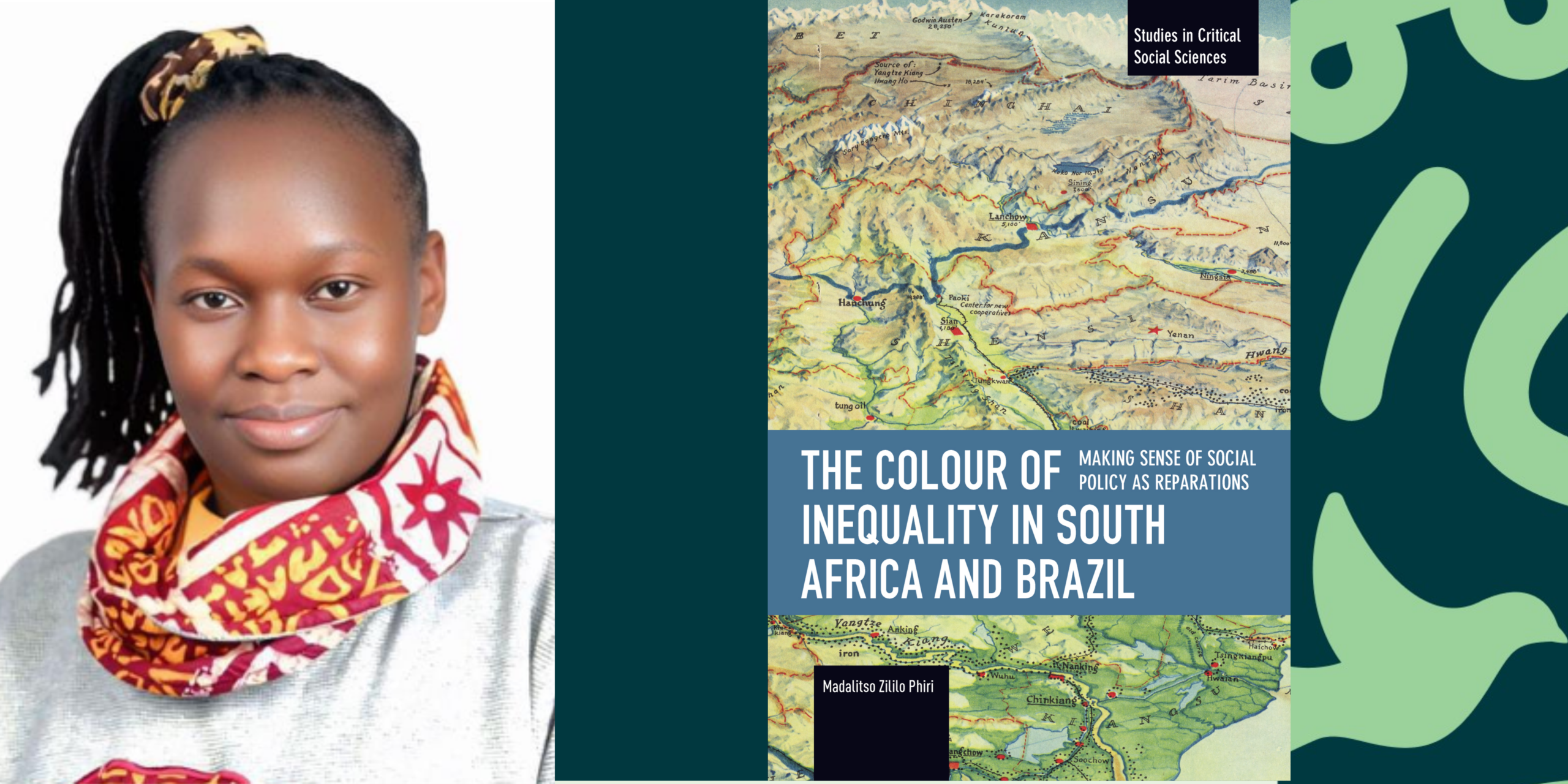
The Colour of Inequality in South Africa and Brazil: Making Sense of Social Policy as Reparations is an ambitious and thought-provoking book. It examines the persistence of racialized inequality in two societies shaped by trans-Atlantic slavery, colonialism, racial capitalism, and anti-Black racism, regardless of both societies’ “progressive” social policies. By bringing South Africa and Brazil into conversation as methodological interlocutors, Phiri centers quotidian narratives of those racialized as Black to interrogate the distribution and accumulation of material, political, and socio-economic advantages and disadvantages. The book moves beyond conventional questions of poverty alleviation and redistribution to ask whether social policy can be understood as reparations, and ultimately as a process of worldmaking.
One formulation stayed with me throughout my engagement with this book. The sentence, “Reparations are a worldmaking project,” captures the scale of the intellectual challenge the book presents before us. If racialized enslavement, colonialism, and imperialism were not simply historical episodes, but constitutive of the institutions, distributions, and hierarchies of the contemporary world, then repair cannot simply mean redistributing resources within that inherited order. This necessitates asking what must be transformed and done differently.
I read the contribution of the book at three interlinked levels: empirical, epistemic, and normative and/or transformative.
This book begins with an empirically compelling paradox. South Africa and Brazil have both pursued ambitious and progressive social policies to address poverty, inequality, and exclusion. Particularly, Brazil’s Bolsa Familia was celebrated as a silent revolution. Yet both societies continue to exhibit profound racialized inequalities in income, wealth, opportunity, citizenship, and power. Phiri asks us to understand this through “cumulative historical material advantage and disadvantage.” The distinction between distribution and accumulation shows how advantages and disadvantages are historically produced, accumulated, and passed on from one generation to another.
Additionally, the book locates its intervention in relation to transformative social policy. While recognizing its wider transformation in capabilities and institutions, Phiri argues that even what is deemed transformative can remain limited where it neglects the historical racialized “other.” The move to social policy as reparations, therefore, changes both the temporal and normative horizons of social policy from present distribution to historical accumulation, progressing from improving inherited arrangements to confronting how those arrangements were constituted.
Epistemically, comparison itself becomes an intervention. Phiri refutes a developmental hierarchy in which Brazil becomes the successful model from which an “infantilized” South Africa should learn. Instead, he proposes the equalization of these two countries as methodological interlocutors. Comparison, therefore, asks not only what works but also who produces policy knowledge, who becomes the model, and who is positioned as the learner. South Africa and Brazil are brought into conversation not only through racial domination but through radical histories of Black freedom imaginaries.
What is equally compelling is the methodological commitment to theorize with interlocutors. Their quotidian narratives do more than illustrate macro-level patterns. They tend to complicate conventional narratives of social policy success by showing how improvements in income and/or access can coexist with persistent precarity and limited capacity to accumulate assets. Experiential knowledge is placed in conversation with political economy rather than subordinated to it.
Normatively, this book does not confuse alleviation, with redistribution, and repair. Its movement, from “giving people money” towards “transferring wealth, assets and opportunities,” crystallizes one of its central provocations: being progressive is not necessarily the same thing as being reparative. Reparations relate to the transformation of all social relations; the re-envisioning and reconstruction of a world system.
However, the book’s conceptual ambition should consider several issues that could benefit from further development. First, the threshold between the progressive, the transformative, and the genuinely reparative remains unclear. This opens an important avenue for research on how reparative social policy might be distinguished analytically and assessed empirically. Second, the commitment to “theorizing” with interlocutors raises a corresponding institutional question, i.e., whether repair itself should be made with—rather than simply delivered to—historically, marginalized communities, and how such co-production might be embedded through the design and governance of repair. Finally, although reparations are compellingly conceived as “worldmaking,” further research could examine the political coalitions and institutional mechanisms that enable reparative social-policy projects to endure, particularly under conditions of political reversal and competing exclusionary projects.
Overall, The Colour of Inequality in South Africa and Brazil: Making Sense of Social Policy as Reparations contributes to comparative social-policy debates on historically produced racialized inequality, using South Africa and Brazil to rethink the relationship between history, inequality, knowledge, and transformation. It leaves us with a demanding question: if inequality were historically made, what would it take to transform the social world?
Reference
Phiri, Z. M. (2025). The Colour of Inequality in South Africa and Brazil: Making Sense of Social Policy as Reparations. Brill.