Biography
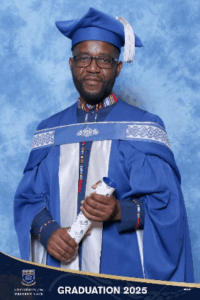
Dr. Gerald Mandisodza is a Postdoctoral Research Fellow at the Dullah Omar Institute, Faculty of Law, University of the Western Cape (UWC), South Africa, where he recently completed his PhD in Comparative Constitutional Law. His research sits at the intersection of democracy, traditional governance, and gender justice. Specifically, he examines how marginalised communities, particularly rural women, navigate and reshape legal institutions within contexts of legal pluralism. Gerald is a recipient of the SSRC’s 2023 Next Generation Doctoral Research Fellowship, which supported the research and writing of his doctoral dissertation.
APDD: Briefly describe the central argument of your doctoral dissertation. What is its main contribution to knowledge in your field?
Dr. Mandisodza: My dissertation, The Role of Forum Shopping in the Construction of Traditional Law Institutions and Women’s Customary Property Rights in South Africa, investigated the strategic ways rural women challenge their exclusion from customary property rights. Despite South Africa’s constitutional commitment to equality, I observed that most rural women living under traditional leadership remained systematically excluded from these rights in practice.
The central argument of my work was that the gap between legal promise and lived reality is not merely a failure of implementation but a “vibrant arena of social struggle.” Through a qualitative case study that triangulated interviews, focus groups, and judicial analysis, I found that women do not passively accept patriarchal norms. Instead, they exercise agency through “forum shopping,” strategically navigating between traditional authorities and state courts to advance their claims.
The main contribution to knowledge is a new tripartite analytical framework that I developed to explain this dynamic: legal invisibility, adaptive legal pluralism, and ambivalent adaptation. I found that while traditional leaders often acted as gatekeepers, women’s strategic choices forced these institutions into an “ambivalent adaptation,” compelling them to evolve and develop or face the threat of losing relevance. Thus, the study proved that traditional institutions are remade from the ground up by the contested actions of the women they govern, rather than evolving only through top-down reform.
How did the Doctoral Dissertation Fellowship Programme impact your doctoral journey?
The Next Gen fellowship served as both a financial lifeline and an intellectual home. On a practical level, the funding gave me the “freedom of time” to immerse myself fully in fieldwork and writing without the pressure of financial insecurity. This support was crucial for conducting the kind of rigorous, on-the-ground research required to understand the lived realities of rural women.
But the impact went far deeper than material resources. The fellowship plugged me into a vibrant pan-African scholarly community. The workshops were a safe space for genuine “cross-pollination of ideas,” where I could present draft chapters and receive critical feedback from mentors and peers across the social sciences. That interdisciplinary engagement forced me to look beyond my specific case study and connect my findings to broader debates on state-building and human security in the Global South.
This environment changed and shaped how I viewed myself. I transitioned from feeling like a student to seeing myself as a producer of knowledge. That shift in confidence gave me the courage to articulate bold theoretical frameworks, like ambivalent adaptation, which became the heart of my thesis. The network I built during this time has also laid the groundwork for collaborations that will continue long into my career.
Now that you have completed your PhD, what are your plans for the future?
I have recently joined the Dullah Omar Institute as a Postdoctoral Research Fellow, where I am working with the Africa Criminal Justice Reform (ACJR) project. My current research focuses on the decriminalisation of poverty, specifically examining how municipal bylaws and governance frameworks disproportionately impact female informal traders and waste reclaimers. This role feels like a natural evolution of my doctoral work; I am applying the same socio-legal lens to understand how law intersects with economic vulnerability and gender in the lives of the poor.
Alongside this new research, I am focused on converting my dissertation into a published monograph and a series of journal articles. It is a priority for me to ensure that the concepts of “legal invisibility” and ambivalent adaptation move beyond the university library, reach policymakers, and other practitioners who can influence and strengthen the status rural women occupy.
Looking further ahead, I aim to expand my research agenda comparatively. I want to investigate how traditional governance structures across the broader Southern African region respond to women’s agency, comparing diverse legal and political frameworks. Finally, I am committed to paying forward the support I received from the SSRC’s Next Gen fellowship. I intend to make postgraduate mentorship and teaching a core part of my career, helping the next generation of scholars navigate the complexities of socio-legal research.
What advice do you have for upcoming doctoral students?
My advice is to embrace the PhD as a process of intellectual “becoming,” rather than just a task to be checked off a list. It is easy to get paralysed by the need for perfection; instead, trust that rigor and clarity emerge from the messy process of drafting and refining. You do not need to get it right the first time; you just need to keep writing.
Although the PhD is often described as a lonely journey, you should not walk the path alone. Build a supportive community early, not just for academic guidance but for moral support. Crucially, invest in a strong relationship with your supervisor. They may offer “tough love” at times, but remember that their role is to guide you toward your goal. Trusting their experience is vital for your growth.
I also recommend adopting what I call a “two-track approach”. Track one is the internal focus: getting the thesis done within the university’s timeframe. Track two is external: making yourself receptive to new ideas and visible by participating in conferences, workshops, and publications. Engaging with networks outside your university boundaries ensures that by the time you graduate, you are already established in the field. Finally, always remain attentive to the real-world significance of your research. Remembering the actual communities your work represents will provide the resilience needed to cross the finish line.
A Selected List of Dr. Gerald Mandisodza’s Publications
Book Chapter
Mandisodza, Gerald. “Beyond Borders: Tackling Human Trafficking Through Structural Reform, Regional Cooperation, and Community Resilience”. In Intractable Problems of Human Rights: A Collection of Essays on Human Trafficking in Africa, edited by G. Mauluka and T. Kaime. University of Bayreuth Press, 2025.
Journal Article (Book Review)
Mandisodza, Gerald. Review of Reimagining Legal Pluralism in Africa: Balancing Indigenous, State, and Religious Laws. African Journal of Legal Studies 17, no. 3 (2025).
Blog Publication
Mandisodza, Gerald. “A Crisis in Plain Sight: Forging a New Strategy Against Human Trafficking in Southern Africa”. African Legal Studies Blog, 2025. Available at: africanlegalstudies.blog
A List of Dr. Gerald Mandisodza’s Research Interests
- Primary Fields: Comparative Constitutional Law, Democracy, Traditional Governance, Political Institutions
- Sub-Fields: Gender and the Law, Legal Pluralism, State-Building, Human Security
A List of Dr. Gerald Mandisodza’s Awards & Fellowships
- Next Generation Doctoral Research Fellow, Social Science Research Council (SSRC), 2023–2024
- Global Scholars Academy Fellow, Institute for Global Law and Policy (IGLP), Harvard Law School, 2024
- Sol Plaatje Social Justice Scholarship Recipient, Canon Collins Trust, 2023–2024
- Doctoral Mentee, CODESRIA College of Mentors, 2023