
Introduction
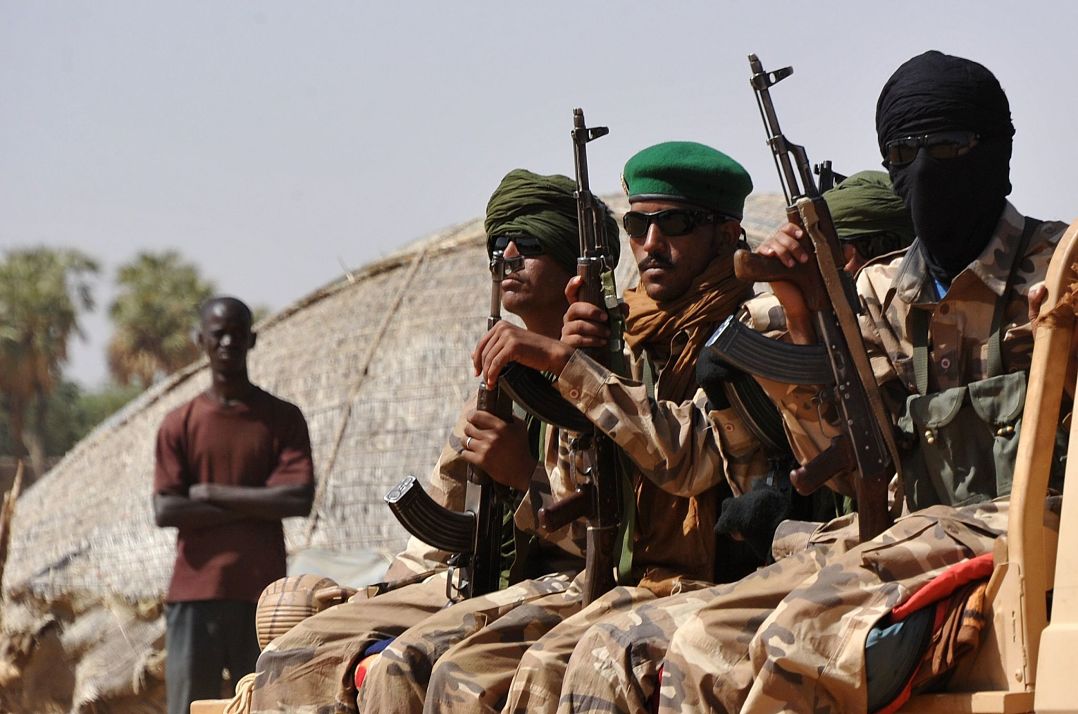
Since 2012, Mali has been embroiled in an armed conflict that has evolved and taken on new forms, involving a variety of actors, including rebel movements, jihadist groups, and self-defense militias. The complexity of this crisis – characterized by the intertwining of political, economic, social, and security factors – renders simplistic explanations of its origins and dynamics inadequate.[1] Several political initiatives, including the Agreement for Peace and Reconciliation resulting from the Algiers process, signed in June 2015, as well as various international and national military interventions (Serval, Barkhane, MINUSMA, Wagner, and Africa Corps), have been launched in an attempt to end the conflict.[2] However, these initiatives have failed to establish sustainable peace. The persistence and geographic spread of violence are reflected in an increase in armed attacks, the closure of schools, the forced displacement of populations, and the disruption of economic and social activities.
The cost of the conflict is politically, economically, and socially high. In this regard, the literature emphasizes that countries facing protracted armed conflicts can find themselves trapped in a “cycle of violence,” which permanently undermines their political and economic development.[3] Conflicts indeed generate considerable costs, not only because of the human and material destruction they cause, but also because of the diversion of public resources toward military and security spending, to the detriment of productive and social investments. In the Malian context, the priority given to the war effort places increasing pressure on public resources and reduces the government’s capacity to promote development. At the local level, armed violence profoundly disrupts production and trade systems, notably by limiting access to markets and weekly fairs, agricultural land, pastures, and fishing grounds.[4] Added to these disruptions are the levies imposed by various armed groups – particularly in the form of zakat, taxes, and other mandatory contributions – which weigh heavily on people’s incomes and livelihoods.
One of the major characteristics of the evolving nature of the conflict in Mali is the emergence and proliferation of militias and self-defense groups, often formed in response to the insecurity and violence suffered by local populations. Their proliferation has not necessarily facilitated the restoration of security or the reestablishment of state authority in conflict-affected areas. In some contexts, it has contributed to reinforcing identity-based and ethnic boundaries, reigniting local rivalries and fueling new cycles of violence.[5]
The 2012 rebellion and the expansion of Jihadist groups have also helped transform local conflicts. Land disputes and long-standing rivalries, previously regulated by local mechanisms of negotiation and mediation, are now intertwined with patterns of armed confrontation and identity-based mobilization. In some localities, clashes between villages and communities are contributing to a reconfiguration of affiliations and power relations, in what can be analyzed as the construction of identity “at the tip of a Kalashnikov.”[6] Violence is therefore no longer merely a manifestation of insecurity but has also become an instrument of territorial control, the regulation of social relations, and governance.
In such a context, the transition from armed violence to lasting peace appears to be a particularly complex process, the terms and conditions of which are not necessarily agreed upon.[7] Building sustainable peace in Africa requires coming to terms with the conflicts that permeate the societies in question; they cannot be addressed solely through security-based responses.[8] This perspective calls for moving beyond an exclusively military and political interpretation of conflict to also examine its economic and social consequences.
This article examines how the presence of Jama’at Nusrat al-Islam wal-Muslimin (JNIM), particularly through the Katiba Macina, is reshaping local economic activities and the exercise of political authority in the Ségou and Mopti regions of Mali. It argues that non-state armed actors do not merely disrupt economic activities or challenge state authority; they also actively participate in reorganizing economic relations, regulating mobility, and redefining local power structures. Through these interventions, they contribute to the emergence of hybrid forms of governance in which economic regulation and political authority are increasingly intertwined.
Beyond Macroeconomic Resilience: The Hidden Local Costs of Armed Conflict
To understand the economic consequences of armed conflict in Mali, it is necessary to move beyond aggregate economic indicators and examine how violence reshapes economic activities, mobility, and livelihoods at the local level. This article focuses on the Ségou and Mopti regions, particularly Niono and Bandiagara, where armed conflict intersects with productive activities, commercial networks, and the everyday movement of people and goods. Rather than treating economic growth and conflict-related disruption as mutually exclusive, the analysis examines how positive national economic indicators can coexist with severe economic and social disruptions in conflict-affected areas.
The following interview extract provides a useful starting point for examining this tension. The extract is analysed not as a comprehensive account of the national economy, but as a perspective that illustrates the tension between the macroeconomic performance promoted by the authorities and the lived realities of populations in areas affected by armed violence.
‘Every bullet we fire is like setting fire to our own money. The same goes for every bomb that is dropped. Just imagine the countless round trips made by the fighter jets, the Sukhois: how much does that cost in fuel, in terms of the budget [amount]? I have just returned from a fundraising mission for the Malian government in the WAEMU region: 100 billion, for an operation that ultimately totaled 117.5 billion CFA francs. But the recovery of the mining sector has also brought in a great deal of money for the government. For example, against a target of 400 billion, the government was able to collect 761 billion CFA francs in 2025, including arrears owed to the Malian government by mining companies. The government expects the implementation of the new Mining Code to generate 580 billion CFA francs each year. This amount is roughly five times greater than what Mali has just raised on the WAEMU financial market. And imagine if this were to continue: how much could it contribute to the government’s budget in the long term? But the conflict is consuming ALL development efforts. We cannot feel the economic progress at the moment. Despite the conflict, Mali has recorded a growth rate of 5.6 per cent and is aiming for even more this year.”[9]
The foregoing quote highlights a central issue: aggregate economic growth does not necessarily translate into improved economic conditions across all territories or social groups. Firstly, it accurately depicts the macroeconomic picture of Mali that the government is promoting, which emphasizes economic growth despite the persistence of armed conflict. World Bank data indicate that Mali’s real GDP grew by 3.1% in 2021, 3.7% in 2022, 4.8% in 2023, and 5% in 2024, and 5.6% in 2025 (Figure 1). These figures point to positive aggregate economic growth rather than a national economic contraction. But this macroeconomic performance partly masks the dynamics of local economies and the daily lives of people living in proximity to non-state armed groups (NSAG).
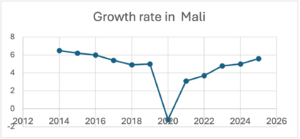
Source: World Bank
If one were to rely solely on aggregate macroeconomic indicators, one might underestimate the human and economic costs of the conflict. Positive GDP growth at the national level does not necessarily reflect the conditions experienced by populations in conflict-affected areas. The consequences of armed conflict are manifested in forced displacement, interruptions to education, restricted mobility, and disruptions of local production and trade. In September 2025, the International Organization for Migration (IOM) and Malian authorities identified 414,524 internally displaced persons across Mali.[10] In the educational sector, 2,036 schools were reported non-functional due to attacks or threats as of May 2025, affecting 610,800 children and 12,216 teachers.[11] These effects are also visible in the local economies of the Ségou and Mopti regions, where armed conflict has disrupted weekly markets, restricted access to farmland, and constrained production and household consumption.[12] Furthermore, JNIM (Jama’at Nusrat al-Islam wal-Muslimin)’s presence and the imposition of blockades or movement restrictions in some localities can further constrain access to markets, productive resources, and essential goods. Such disruptions are poorly captured by aggregate GDP growth figures, underscoring the need to examine how conflict reshapes economic activities and livelihoods at the local level.
It is therefore necessary to look beyond the macroeconomic figures to understand peoples lived experiences and the dynamics of local economies in areas affected by the conflict. One can, however, choose to see the glass as half full, or half empty. I am not opposed to this perspective, as it allows us to acknowledge the efforts made, the progress achieved in the military sphere, and the country’s macroeconomic performance. But the risk, when we only see the glass as half full, is that we ignore the losers of the security policy pursued since the start of the conflict, which relies increasingly on a military approach.
The other perspective, although it may seem more pessimistic, is therefore to also consider the half that is empty. This provides a better understanding of the situation of populations living in conflict zones, particularly those facing a strong presence of Jihadist armed groups.
Transformation of local economies and networks of dependency
Strategic connectivity
The cases of Niono and Bandiagara illustrate how the economic significance and geographical connectivity of localities in Ségou and Mopti regions shape their exposure to armed conflict and their strategic importance for armed groups. Located in the Ségou and Mopti regions, respectively (under the former administrative boundaries), both towns occupy key positions within regional production, trade, and transport networks, although their economic structures differ.[13]
Bandiagara’s strategic importance lies primarily in its role as a commercial hub connecting local markets to wider regional and cross-border trade networks, particularly through livestock and essential goods. Niono, by contrast, derives much of its economic significance from irrigated rice production in the Office du Niger, alongside livestock farming, fishing, and its position within transport networks linking several regions of Mali. These economic characteristics make both localities important not only for production and exchange but also for the circulation of people, goods, and resources.
Such economic connectivity also creates opportunities for armed groups to exercise influence over local economies. By controlling or restricting access to markets, transport routes, and productive resources, armed actors can disrupt economic activities while simultaneously establishing new forms of regulation and authority. The significance of Niono and Bandiagara therefore extends beyond their geographical location or economic potential: they provide contrasting settings for examining how armed conflict reshapes economic relations, mobility, and local governance in Ségou and Mopti regions.
Weakening of the pillars of the local economy
Ségou and Mopti communities are subjected to recurrent attacks by JNIM, but also by local militia, Dozo, with repeated assaults leaving villages in ruins and agricultural land inaccessible for cultivation. These attacks weaken local economies by disrupting their main pillars: weekly markets, agriculture and livestock, and mobility.[14]
Attacks by JNIM disrupt the holding of weekly fairs. These fairs are central to local economies in Mali, providing key spaces for people to exchange goods and services, purchase essential goods, and sell locally produced products, whilst connecting producers, traders, and consumers through wider supply networks. Consequently, when insecurity disrupts the regular holding of fairs, the effects extend beyond the market itself, disrupting the wider local economic system and the connections between production, trade, and consumption.[15]
In some cases, people have stopped attending these markets due to insecurity along the roads. In other cases, markets have ceased to function because of the presence of Jihadist groups or blockades imposed by JNIM. For example, the market in Fatoma has been severely affected, whilst people in Saye have stopped attending the market as a result of the blockade imposed by JNIM. Even where production remains possible, armed groups can impose further restrictions on economic activities. In some localities, for example, people are prevented from cultivating their land or engaging in other productive activities.[16]
The second major economic activity that is adversely affected by insecurity is agriculture and livestock farming. In Niono, in the Ségou region of Mali, these activities form the backbone of the local economy. However, they have been severely disrupted by the activities of various armed groups, including jihadist groups, and Dozo, local self-defense militias. During conflict, farms are burnt, livestock is seized, and in some villages, armed groups have explicitly banned farming. These restrictions not only reduce local food production but also undermine the livelihoods of communities that depend heavily on agriculture and livestock farming.[17]
Blockades as instruments of governance and regulation
Apart from the disruptive impact of violence by non-state and state actors, the blockades imposed by JNIM in Saye, Marébougou and Kori-Maoundé, as well as the attacks targeting the Parou-Songobia bridge, are shaping governance in the conflict-affected regions. The three localities were placed under direct blockade at different times: Kori-Maoundé from 2019, Marébougou in 2021, and Saye in 2023. The case of the Parou-Songobia bridge is different, as it is located in an area under JNIM influence, where attacks and abductions are regularly carried out.
This article also focuses on three forms of blockade. In Marébougou, the blockade is swift and total. It lasted six months, starting in September 2021. This contrasts with the case of Saye, where the blockade was gradual from 2023 and intensified in 2024, resulting in the forced displacement of people from surrounding villages and exacerbated humanitarian and economic pressure in the region. In Kori-Maoundé, the blockade had been building up gradually since 2019 through attacks, restrictions on movement, and targeted assassinations. By 2024, the situation had worsened with the ban on transport operators serving the village.
Benkan: a system of control through violence
JNIM’s use of blockades, through attacks and restrictions on movement, forms part of a broader strategy that could be described as ‘governing through immobilization.’ To demonstrate and consolidate its authority, JNIM imposes the benkan, presented as an agreement or a pact with communities. However, the benkan is not a genuine agreement between two parties. It functions more as a system of control based on coercion and violence, through which JNIM seeks to impose its authority on the population.
The imposed benkan required the payment of zakat on crops and livestock, prohibited music at social events (including celebrations and weddings), mandated school closures, and required women to wear the veil.
It is also important to highlight the double burden faced by women in areas under blockade or occupation by JNIM: domestic workload has been compounded by economic pressures, violence, and the restriction of movement due to the blockade. Our research showed that the restricted mobility affected women and men differently. Before the imposition of the blockades, women were the backbone of the local economy. They played key roles in mutual aid and microcredit associations, market gardening, livestock farming, and trade at the bazaars. The advance of the Katiba Macina, a non-state armed group known as a jihadist group, severely disrupted these activities, limiting their opportunities for economic activity[18].
The Parou-Songobia bridge: infrastructure as a barrier and a tool for extortion
The impact of Katiba Macina’s strategy of governance through its asymmetric strategy of controlling movement is also evident along major roads and illustrated by the case of the Parou-Songobia Bridge. Located on National Road 15 (RN15), some 25 kilometers southwest of Bandiagara.[19] This bridge is a vital artery linking Sévaré, Bankass and Koro to the border with Burkina Faso. Dubbed the ‘road of death’ by the press, at least 116 civilians lost their lives in the immediate vicinity of this bridge between 2017 and 2020. By 2024, this grim toll had risen to at least 120 civilians killed in targeted attacks on minibuses and passenger coaches.
The attacks of 25 April 2026: an attempt to place Bamako under blockade
The coordinated attacks by JNIM and FLA (Front de libération de l’Azawad) on centres of power (Kati, Bamako) and the announcement of a total blockade were intended to project an impression of control over territories at the heart of the state. In the early hours of 25 April 2026, shortly before 5.20 am, explosions and heavy gunfire rang out in Kati, Mali’s main military base, and the residence of General Assimi Goïta, President of the Transitional government. JNIM claimed responsibility for the series of coordinated attacks targeting the presidential palace, the Ministry of Defence, Bamako-Sénou International Airport and several military installations.[20] At the same time, the Azawad Liberation Front (FLA) claimed control of Kidal and parts of Gao, while the Islamic State in the Sahel (IS-SP) launched attacks on other towns. Mali’s Defence Minister Sadio Camara was killed while the head of the intelligence services was wounded.[21] According to several analysts, these coordinated attacks constitute the largest offensive in Mali since the 2012 rebellion.[22]
Three days after these coordinated attacks, on 28 April, Bina Diarra, the spokesperson for JNIM, announced the total blockade of Bamako. According to him, this blockade was intended to prevent any means of transport (bicycles, carts, buses, cars) from entering Bamako. The only concession granted to the population was permitting those who had returned to Bamako before the attack to leave.
The announcement of the blockade was followed by acts of violence against passengers on many routes leading to Bamako. On the Ségou–Bamako route, many passenger coaches were set alight, whilst passengers looked on helplessly. The announcement of the blockade and the attacks on passenger coaches and lorries led to a change in routes, forcing vehicles to take a detour through the Faya protected forest, located in Kesela, before reaching Bamako. The Ségou – Zantiguila – Kasséla – Bamako route became the Ségou – Zantiguila – Koulikoro (via the Kayo Bridge) – Bamako route. The change in route also affected the Kayes–Bamako route, which was changed to Kayes–Bafoulabé–Kita–Bamako instead of the Kayes–Diéma–Bamako route. This change led to an increase in travel distance, transport costs (including ticket prices and fuel costs), and travel time.
The effects of the announced blockade on Bamako placed an additional burden on the Malian Armed Forces (FAMA), forcing them to escort passenger convoys on several routes such as Bamako–Kayes, Bamako–Ségou and Bamako–Sikasso.[23] To circumvent the announced blockade of Bamako, convoys had to be organized on the main routes under military protection to enable travel to Bamako.[24] This enabled a large number of Malians to travel to the interior of the country to celebrate the Eid al-Adha festival. However, the attacks caused a significant disruption to the country’s petrol and diesel supply chain. Tanker lorries carrying hydrocarbons from Senegal now stop at Kayes, unable to reach Bamako, even though around 85 per cent of the country’s hydrocarbons were previously imported from Senegal. Subsequently, Bamako is now mainly supplied via the Abidjan route through Sikasso,[25] but also via convoys organized and escorted by the FAMA.
Jihadist Presence and the Reconfiguration of Trade Flows
The targeting of fuel supplies from Senegal is radically altering the country’s supply chain, strengthening the group’s authority by disrupting the national economy. Against a backdrop characterized by the weakening, or even the absence, of state authority in the areas surveyed in the Ségou and Mopti regions, trust in Malian state institutions is eroding, whilst conflicts (over land, pastoralism, and community issues) persist in the face of the ineffectiveness of endogenous mechanisms. It is against this backdrop that armed groups emerge and establish themselves as regulatory actors through the use of force. These groups are gradually establishing a parallel justice system based on arbitrary rules or those inspired by ideological, religious, or opportunistic norms, characterized by swift and dissuasive sanctions without any guarantees of the right to defence. Mediation under coercion by armed groups relies on the use of violence. Weapons become a prerequisite for dialogue; agreements are rarely negotiable, remain unbalanced, and their implementation is strictly controlled.
In situations of blockade, certain intermediaries – notably imams, local elected representatives, and community leaders – influence the possibility, nature, and outcome of discussions with jihadist groups. The cases of Marébougou, Saye and Kori-Maoundé illustrate contrasting scenarios. In Marébougou, the involvement of locally elected representatives helped to establish a channel of dialogue with the Katiba Macina, facilitating exchanges and contributing, temporarily, to limiting the escalation of violence. In Saye, by contrast, the residents’ refusal to engage in a benkan and the lack of initiative on the part of certain local authorities prevented dialogue from taking place, further isolating the village. In Kori-Maoundé, direct dialogue remains limited by the presence of Dan Na Ambassagou, a self-defense militia, who is hostile to any negotiations with Katiba Macina. At the same time, mediation initiatives reportedly undertaken between April and July 2025 by the Ministry of National Reconciliation and the Bandiagara Governorate were conducted at the regional level and did not specifically address the situation in Kori-Maoundé. These cases thus demonstrate that the presence, legitimacy, and positioning of mediators are key factors in the scope for negotiation and the evolution of blockade situations.
Conclusion
This article has shown that JNIM and other Jihadi groups do not simply disrupt state governance or local economic life. Rather, they actively reconfigure local power relations and contribute to the emergence of hybrid forms of governance.
The cases presented from Ségou and Mopti show how violence, blockades, restrictions on mobility and attacks on economic networks have become mechanisms through which JNIM exercises authority and shapes the conditions under which people live, trade, move and negotiate.
Therefore, understanding the ramifications of JNIM’s governance style requires looking beyond confrontation with the state. The impact of its power and activities also manifests in the disruption and regulation of everyday economic and social life.
Endnotes
- Benjaminsen, T.A.; Ba, B. Fulani-Dogon Killings in Mali : Farmer-Herder Conflicts as Insurgency and Counterinsurgency Fulani-Dogon Killings in Mali : Farmer-Herder Conflicts As. African Secur. 2021, 14, 4–26, doi:10.1080/19392206.2021.1925035.
- Sandor, A.; Campana, A. Les Groupes Djihadistes Au Mali, Entre Violence, Recherche de Légitimité et Politiques Locales. Can. J. Afr. Stud. 2019, 53, 415–430, doi:10.1080/00083968.2019.1667838.
- Cox, G.W.; North, D.C.; Weingast, B.R. The Violence Trap: A Political-Economic Approach to the Problems of Development. J. Public Financ. Public Choice 2019, 34, 3–19, doi:10.1332/251569119X15537797528769.
- Tangara, M.B. The Effects of Armed Conflicts on Local Economic Dynamics in the Mopti and Ségou Regions of Mali. 2024, 19, 35–56, doi:10.15355/epsj.19.2.35.
- Chebli, D. Économie Transnationale de La Violence et Autonomisation Des Milices Au Nord Du Mali. Cult. conflits 2022, 95–113, doi:10.4000/conflits.23640.
- Poudiougou, I.; Zanoletti, G. Fabriquer l’identité à La Pointe de La Kalache. Rev. Int. des études du développement 2020, N°243, 37, doi:10.3917/ried.243.0037.
- Cravo, T.A. Consolidation de La Paix: Postulats, Pratiques et Critiques. 2018, 5–21.
- Brun-picard, Y. S’approprier Les Conflictualités En Afrique Pour Construire Une Paix.
- Interview with a financial administrator, Bamako, 18 July 2026.
- https://dtm.iom.int/datasets/mali-baseline-assessment-round-83?utm_source=chatgpt.com
- https://dev.educationcluster.net/news/protecting-education-attack-through-strong-coordination-mali?utm_source=chatgpt.com
- See Tangara, M. B. (2024).
- See Tangara, M.B. (2024).
- See Benjaminsen et Ba (2021) Poudiougou (2023) ; Tangara, M.B (2024)
- Tangara, M. B. & Poudiougou, I. (2025). Vivre sous blocus : cas des zones sous influence du JNIM au Mali. SIPRI Insights on Peace and Security, Working Paper No. 5. Stockholm International Peace Research Institute (SIPRI). https://doi.org/10.13140/RG.2.2.20665.43361
- ACAPS. “Mali: Situation of Internal Displacement.” Briefing Note, June 7, 2024. https://www.acaps.org/fileadmin/Data_Product/Main_media/20240607_ACAPS_Briefing_note_Mali_-_Situation_of_internal_displacement.pdf.
- See Tangara (2024)
- See Tangara, M. B. & Poudiougou, I. (2025).
- Tapily, Mamadou. “As Army Operations Ramp Up in Mali, Rebel Groups Impose ‘Suffocating’ Blockades.” The New Humanitarian, March 12, 2024. https://www.thenewhumanitarian.org/news-feature/2024/03/12/mali-army-operations-rebel-groups-impose-suffocating-blockades.
- Reuters. “Mali Army Bases Hit in Large-Scale Attacks Claimed by al Qaeda-Linked Militants.” April 25, 2026. https://www.reuters.com/world/africa/loud-blasts-gunfire-heard-near-malis-main-military-camp-reuters-witness-says-2026-04-25/
- Al Jazeera Staff. “Mali’s Defence Minister Sadio Camara Killed during Coordinated Attacks.” Al Jazeera, April 26, 2026. https://www.aljazeera.com/news/2026/4/26/malis-defence-minister-sadio-camara-killed-amid-coordinated-attacks
- Wilén, Nina. “Mali Meltdown: Coordinated Attacks and Their Consequences.” Egmont Institute, April 27, 2026. https://egmontinstitute.be/mali-meltdown-coordinated-attacks-and-their-consequences
- Forces Armées Maliennes. “Sécurité: Vaste opération d’escorte et de sécurisation des véhicules civils sur le tronçon Kayes–Bamako.” June 30, 2026. https://fama.mil.ml/posts/securite-vaste-operation-descorte-et-de-securisation-des-vehicules-civils-sur-le-troncon-kayes-bamako
- Associated Press. “Eid al-Adha in Mali’s Capital: Soaring Sheep Prices amid Blockade.” AP News, May 27, 2026. https://apnews.com/article/mali-insecurity-eid-aladha-bamako-jnim-4011ccc0a85421c83d5365d2201fadfa
- Faye, Mamadou, and Abdou Karim Bah. “Pénurie de carburant au Mali: comment l’État compte contourner les effets du blocus imposé par le JNIM?” BBC News Afrique, October 8, 2025. Updated October 9, 2025.