
Introduction
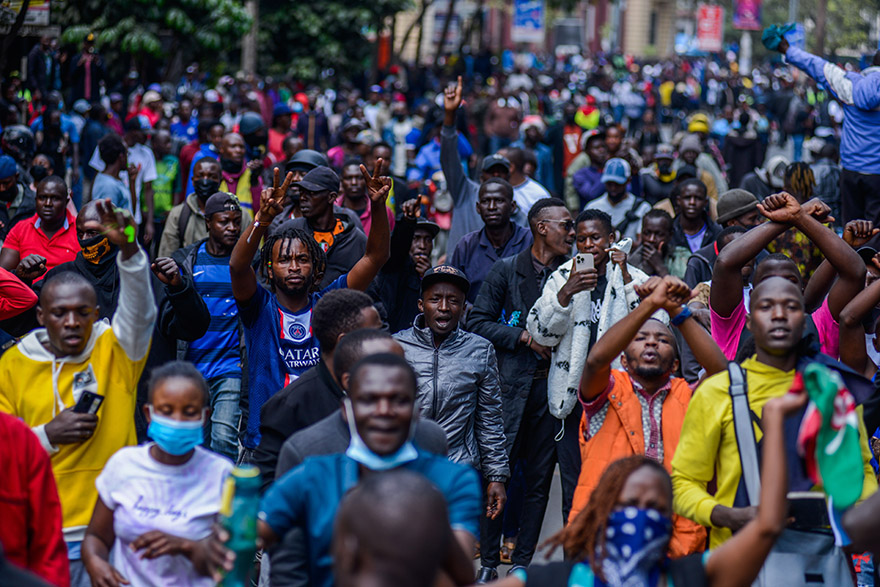
Following weeks of anti-tax protests in Kenya, demonstrators, in an unprecedented move, set the Parliament buildings ablaze on 25th June 2024 as members of parliament (MPs) passed the controversial Finance Bill 2024. Media and other sources estimate the number of fatalities from police shootings at more than 20 young people on the fateful day, with several other deaths and cases of disappearance in the following weeks.[1]
Famously dubbed the ‘Gen Z protests,’ young people mobilized through various social media platforms to protest government proposals for increased taxation and ongoing austerity measures. Citing the high cost of living, inflation, and high unemployment rates, the youth-led protesters under the hashtag #RejecttheFinanceBill2024 mobilized and held demonstrations across the country demanding the government’s withdrawal of the Bill, which they argued had been orchestrated by the International Monetary Fund (IMF). Linking the punitive measures contained in the Finance Bill 2024 to the Bretton Woods institutions, protesters carried placards with various demands such as “IMF Go Home,” “Kenya is not for sale,” “Ruto is IMF Village Elder in Kenya,” “IMF We are Not your Lab rats,” symbolizing widespread resistance to the government and IMF-induced taxes and austerity measures on the nation’s fiscal policy.
It is against this backdrop that this article examines the youth-led protests, particularly the role of the International Financial Institutions (IFIs) in fomenting the Gen Z demonstrations. It also examines how an IMF-imposed conditionality structured Kenya’s social policy terrain and fueled the conditions for the 2024 protests. Drawing upon policy coloniality[2] as an analytical frame, this essay asks: in what ways did IFI conditionalities constitute policy coloniality, and how did this engender the protests? Deriving from an analysis of documents and field interviews, we conclude that conditionalities translate to the “self-allocated right to make policies for others” as well as the obliteration of policy space, constituting policy coloniality, and that the protests represent a democratic call back to sovereignty.
The IMF and conditionalities
Created amidst the cataclysmic violence of World War II, founders of the IMF and World Bank conceived the role of the two institutions as one fostering global cooperation, development, and peaceful reconstruction.[3] Arising from hegemonic power and narrowly deterministic economic conditionalities attached to lending agreements, IFIs’ prescriptions to countries in financial distress tend to fuel conflict as well as the conditions of “choiceless democracy.”[4] Unable to alter policy through democratic mechanisms, citizen resistance takes the form of protests against unpopular government policies.
Policy Coloniality
The distinction between norm-setting and policy neo-colonialism is important in understanding policy coloniality. Norm-setting is associated with policy learning and acceptance of conventions negotiated based on contextual understanding and nationally defined agendas. A key feature of norm-setting is the preservation of policy autonomy. However, policy coloniality, as Adesina argues, does not serve to inform national policymaking, but is the imposition of those advancing policy coloniality, who then “operate based on the self-allocated right to make policy for others.”’[5] Grounded in structural mechanisms, policy coloniality derives from the hegemonic power of international financial actors to subordinate nations reliant on financial bailouts, compelling them to implement certain policy prescriptions.[6] This understanding is useful in illuminating the effects of continued imposition of IFIs in postcolonial countries and the perpetuation of the colonial matrix of relationships.
Assessing the impact of IMF policies on the Kenyan social policy terrain
To assess the effects of the IMF lending on Kenya’s social policy, this article has disaggregated loan conditions and linked them to specific social policy outcomes. Views from participants in the study also informed aspects discussed herein. First, the reduction in social spending led to cuts in education, health, and social protection, notwithstanding the IMF’s strategies for safeguarding social spending. As reflected in various documents, fiscal consolidation measures by the IMF from 2020 to 2025 required deficit reduction, expenditure control, and increased tax revenue, reflecting the institution’s dominant ideological orientation towards macroeconomic stability over social spending.
Second, the mean-testing models introduced for health and higher education cemented arbitrary exclusions, reinforcing past targeting models of social policy provisioning in Kenya. Those enrolled in the Social Health Insurance Fund highlighted difficulties in accessing services, driving out-of-pocket payments. To fulfil IMF’s fiscal objectives, enhanced models of targeting resulted in shifting increased costs for access to services from the state to households. The IMF’s imposition of heavy targeting models on programs designated for the poorest, like Inua Jamii,[7] under the guise of improving efficiency, constitutes the imposition of a social policy model that only intervenes for the ‘deserving poor.’
In his first week in office, President Ruto removed subsidies on maize meal and fuel, thereby fulfilling a pending unmet IMF conditionality from the previous regime. The removal of the subsidies led to price inflation of basic goods, sparking the “sufuria revolution.”[8] In the first review following Ruto’s election the 4th ECF/EFF Review, December 2022, the IMF commended the President on the move as follows;
The program is delivering results; increased tax revenue and careful spending are stabilizing debt as a share of GDP well below levels originally projected. Kenya accomplished this because of strong commitment from the Ruto administration, facing pending bills last year and unbudgeted spending from early this year. They took bold action. They fully phased out petrol subsidies, and they’re finding cost savings to hold this year’s deficit below the budgeted level.[9]
By praising the President for removing the subsidies, the IMF was commending a politically damaging action that triggered the sufuria street protests. Foreseeing the likelihood of further protests after these initial protests in 2022, the IMF Country Report No.24/13 of the 6th review under the EFF and ECF arrangement, published in January 2024 appearing in the risks assessment section classified ‘renewed social discontent’ as a risk to fiscal consolidation and stated thus:
Unrest could re-emerge in connection with protests against the higher cost of living, the need to raise more taxes, and the electoral process supported by the political opposition.[10]
The mitigation strategy proposed by the IMF to this effect in the risk assessment section stated, “Remain committed to reforms,’[11] in effect urging the government to ignore democratic calls from citizens.
Facing tight fiscal consolidation requirements, changes in taxation and austerity measures proposed in the Finance Bill 2024 aimed to raise an additional KES 302 billion to cover the budget deficit. Participants in the study were of the opinion that the document had been crafted under pressure from the IMF and the World Bank, citing several reasons. First, the inability of government officials to articulate proposals on land taxation and vehicle circulation tax was read by participants as external authorship of the Finance Bill.The mitigation strategy proposed by the IMF to this effect in the risk assessment section stated, “Remain committed to reforms,’[11] in effect urging the government to ignore democratic calls from citizens.
Second, highlighting the disconnect between the contents of the Finance Bill and the reality and cultural context of the people in terms of land, participants opined that this tension further indicated that the contents of the Finance Bill 2024 had been externally authored and imposed on the government, echoing Adesina’s sentiments on the “self-allocated right to make policy for others”.
Pointing to the proposed annual land tax on freehold land in urban areas in the Finance Bill 2024, respondents in the study argued that through the new levy the government was imposing the additional tax to push out smallholders in rural areas. Questioning the motivation behind the proposal, youths participating in this study expressed the view that the political elite wanted to push them from their ancestral land. The inclusion of a tax on land in the Finance Bill heightened tension in the context of an already low level of trust in the government. In Kenya, as in other settler colonies, the land question remains contentious and unresolved, decades after independence.[12]
Obliterating the policy space and subverting democracy
Interpreting the protests as a risk to be managed, the IMF disregarded them as a call for democratic deliberation. In addition, the framing considers the fiscal consolidation path as the only route to sustainability, reflecting neoliberal claims of “there is no alternative” (TINA).[13] According to the IMF, citizen resistance presented risks rather than responses to unpopular policies. Forced into dual accountability, with the domestic electorate on one side and the need to fulfil externally-imposed conditionalities related to IMF borrowing on the other, government action to remove subsidies sparked the initial sense of betrayal of a “false dawn” reminiscent of the period after independence.[14] Referring to this external accountability to IFIs, and voters as serving “two constituencies,” Mkandawire argues that donors, even while investing in democratization, circumscribe the reach of domestic democratic institutions and hollow out governments’ accountability to citizens, creating a tension of voters versus donors.[15] Cognisant of this tension and pressure on government, a participant drawing upon Mkandawire’s concept of “choiceless democracy” described how the government had no viable exit from IMF conditionality, as this would mean loss of financing leading to political consequences. Noting that the mechanisms of choicelessness are characterised by erosion of national sovereignty, the government is pressured to follow standardized economic policies and therefore is locked into performance criteria laid down by the IMF.[16] In this regard, the government’s failure to meet the targets would trigger financial risks.
Following the youth-led protests, the IMF diagnosis attributed the blame to the government’s communication skills, thus:
Reforms to make the tax regime more efficient, equitable, and progressive, as well as strengthening accountability, transparency, and efficiency of public finances, will help garner political and societal support for reforms. Clearly communicating the necessity and benefits of the reforms is paramount.[17]
Conclusion
Policy sovereignty remains an elusive mission for many postcolonial states of Africa. Saddled with a host of structured exogenous interventionist forces, the state in Africa is often limited in space to shape and define its path in social policy.[18] Policymaking arenas inhering powerful international actors rob governments, on the one hand, of the autonomy to chart their path based on social and economic realities and, on the other, deny citizens the democratic opportunity to define social policy that suits their realities. With the forceful retreat of the state, discriminatory and minimalist forms of state provision led to democratic demands by citizens, often perceived as a threat to the power and privilege of political and economic elites. In Kenya, the conflict that occurred in 2024 arose due to the progressive escalation of demands by citizens through organized movements like the Gen Z protesters, which have so far strained the fabric of democracy to its limit. As has happened in the case of Kenya, the state can be overtaken by political crisis. As a means of coping, the state begins to lose its democratic character, resorting more to the use of coercive power.[19] When this happens, the political and economic elite often remain aligned with the state, sometimes legitimizing state violence in the name of political stability and national unity.[20]
Endnotes
- KHRC & IMLU, “A year of blatant state repression through regime policing,”
- Adesina, “Global Social Policy and Policy Sovereignty” (7-11).
- Dolan-Evans, “Making war safe for capitalism” (531–549.
- Mkandawire, “Crisis Management and the Making of ‘Choiceless Democracies’ in Africa” (119 -136).
- Adesina, “Global Social Policy and Policy Sovereignty” (9).
- Maloba,” The Anatomy of Neo-Colonialism in Kenya”
- Inua Jamii is the Government of Kenya’s flagship National Safety Net Program (NSNP) managed by the Ministry of Labour and Social Protection. It provides regular cash transfer to vulnerable citizens across the country.
- Sufuria Revolution was a protest started as a symbol of widespread hardship, high taxation, and soaring cost of living under President Willam Ruto’s administration. Sufuria means cooking pot in Swahili.
- IMF Media Centre, Washington DC, 19 December 2022
- IMF, “Kenya: Sixth Review” (Appendix 1)
- Ibid
- Kameri-Mbote and Kindiki, “Trouble in Eden” (167 – 193).
- Hormeku-Ajei et al, “Introduction” (1 -30).
- Mati, “Political Protest in Contemporary Kenya”
- Mkandawire, “Aid, accountability, and democracy in Africa” (1149 – 1182).
- Mkandawire, “Crisis Management and the Making of ‘Choiceless Democracies’ in Africa”
- IMF, “Press Release No 24/398, 7th and 8th Reviews, 30 October 2024. “
- Ouma and Adesina, “Solutions, exclusion and influence” (379 – 395).
- Adesina, “Social policy in sub-Saharan Africa” (37 – 51); Sheth, “Movements, intellectuals and the state” (425 – 429).
- Sheth, “Movements, intellectuals and the state” (425 – 429).